
Durable Storage
A stream registered with durable: true writes every publish to a segmented,
checksummed, crash-safe log before the publish is fanned out or acknowledged.
This page covers what that guarantees, how it is built, and what it costs.
The guarantee
Section titled “The guarantee”A record that a durable publish acknowledged is readable after a restart, within the window the configured fsync policy allows.
The window is zero for OnCommit, one interval for Periodic, and
undefined for None.
Durability is opt-in. A broker started without FELIX_DURABLE_STORAGE_DIR is
in-memory only, and a stream the control plane marks durable is rejected at
registration rather than silently downgraded to a guarantee the broker cannot
keep.
Durability is immutable while a stream is registered. Remove and recreate a stream to change it between ephemeral and durable; this explicitly invalidates old handles and prevents durable offsets from diverging from existing in-memory cursors.
Ordering: append, then fanout, then ack
Section titled “Ordering: append, then fanout, then ack”flowchart LR
C(["Client"]) e1@--> P["publish"]
P e2@--> L[("durable log<br/><small>append + assign offsets</small>")]
L e3@--> D{{"fsync<br/><small>OnCommit only</small>"}}
D e4@--> F["fanout"]
F e5@--> S1(["Subscriber"])
F e6@--> S2(["Subscriber"])
D e7@--> A(["ack to client"])
e1@{ animate: true }
e2@{ animate: true }
e3@{ animate: true }
e4@{ animate: true }
e5@{ animate: true }
e6@{ animate: true }
e7@{ animate: true }
classDef store fill:#fdf0e3,stroke:#b07d3a,color:#3d2a12
classDef gate fill:#fbe9d6,stroke:#b07d3a,color:#3d2a12
classDef step fill:#e8f0fe,stroke:#4a6fa5,color:#1a2b40
classDef edge fill:#e9f5ec,stroke:#4a8a5e,color:#16301f
class L store
class D gate
class P,F step
class C,S1,S2,A edge
Nothing downstream of the log observes a record before it is durable: fanout and the acknowledgement both hang off the flush, not off the append. Ordering is the whole design, so the same path is worth spelling out step by step:
sequenceDiagram
    autonumber
    participant C as Client
    participant B as Broker
    participant L as DiskLog
    participant D as Device
    participant S as Subscribers

    C->>B: publish(payload)
    B->>L: append(records)
    L->>L: encode batch, one write() to the page cache

    alt FsyncMode::OnCommit
        L->>D: fsync (shared with concurrent appends)
        D-->>L: durable
    else None / Periodic
        Note over L: returns immediately —<br/>a background timer flushes later
    end

    L-->>B: offsets assigned
    B->>S: fanout
    B-->>C: ack
The append comes first, on purpose. A record delivered to subscribers and acknowledged to the publisher but lost in a crash is a silent hole in a log that consumers believe they have read. Writing first turns a storage failure into a failed publish, which the publisher can retry — and it means a storage error can never produce a success acknowledgement.
Durability policies
Section titled “Durability policies”| Mode | Flush trigger | Acknowledged when | Loss window |
|---|---|---|---|
none |
seal, shutdown | bytes reach the page cache | unbounded |
periodic { interval } |
background timer | bytes reach the page cache | one interval |
on_commit |
the append itself | bytes reach the device | none |
none is not “no durability”: data survives a process crash, because the page
cache belongs to the kernel. It does not survive a machine crash or power loss.
periodic is the default. It is the only policy whose cost is invisible on the
append path while still bounding loss.
On-disk layout
Section titled “On-disk layout”graph TB
subgraph shard["one directory per stream shard"]
direction TB
S0["00…000.log — sealed<br/><small>offsets 0–999</small>"]
I0["00…000.index"]
S1["00…001.log — sealed<br/><small>offsets 1000–1999</small>"]
I1["00…001.index"]
S2["00…002.log — <b>active</b><br/><small>offsets 2000–…</small>"]
I2["00…002.index"]
end
S0 -.-> I0
S1 -.-> I1
S2 -.-> I2
classDef sealed fill:#eef1f5,stroke:#7a8699,color:#2b3444
classDef active fill:#e9f5ec,stroke:#4a8a5e,color:#16301f
classDef index fill:#e8f0fe,stroke:#4a6fa5,color:#1a2b40
class S0,S1 sealed
class S2 active
class I0,I1,I2 index
Appending, and reading back
Section titled “Appending, and reading back”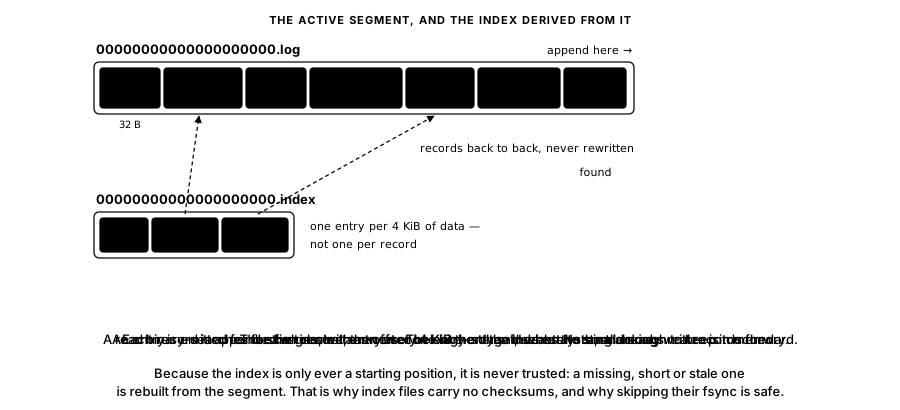
Each record carries its own length, logical offset, timestamp and a CRC-32 over its header and payload. The length comes first and is covered by the checksum, so a reader can step to the next record without decoding the current one’s payload — which is what makes index rebuilds and recovery scans cheap.
Index files are pure accelerators. An entry is emitted for a segment’s first
record and thereafter every index_spacing_bytes (4 KiB by default), so the
index is sparse: it says roughly where to start, and the forward scan over
real records is what actually answers the read.
That is also why they carry no checksums and are never trusted. An entry is only ever a starting position for a scan that re-validates what it finds, so a missing, short, or stale index costs a rebuild rather than a wrong answer — and it is why a freshly written index can safely skip its fsync.
Sealing, rolling, and retention
Section titled “Sealing, rolling, and retention”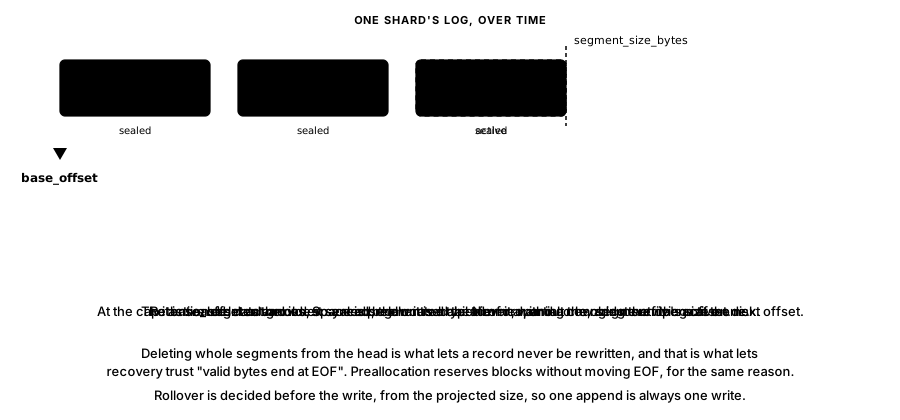
A shard’s log is one active segment plus any number of sealed ones.
Rollover is decided before a write, from the projected size, so one append is
always one write call and a batch never spans two segments. Sealing syncs the
data and the index, then trims the preallocated tail so the file on disk is
exactly its contents.
Retention deletes whole sealed segments, from the head only — never a
partial segment and never the active one, so a log always retains at least what
was written since its last roll. base_offset then advances, and a read below
it is Trimmed { requested, oldest } rather than an empty answer. That
distinction is the point of the feature: it lets a resuming subscriber tell
“those records existed and are gone” from “nothing here yet”.
The full byte layout, versioning rules, and corruption verdicts are in the Durable Segment Format specification.
Resuming a subscription
Section titled “Resuming a subscription”Durability is only half of a resume: records surviving a restart is worthless if
a reconnecting client cannot say where it got to. A subscriber asks for a start
position — latest, earliest, or an exact offset — and every delivered event
carries its offset, so the client has something to checkpoint.
The hard part is not reading history. It is joining history to live delivery without losing a record in between, and the ordering that achieves it is not the obvious one.
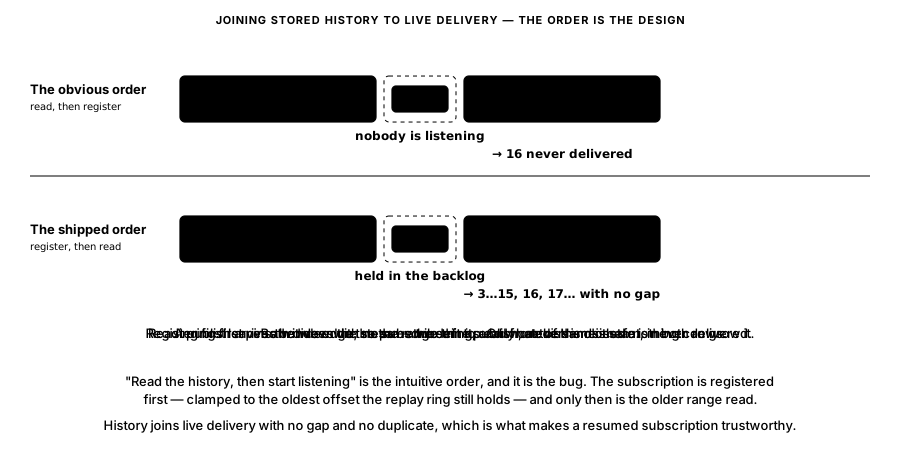
Registering first pins the live edge. Everything below it is a closed range — nothing can grow it — so the disk read that follows cannot race a publish. Do it the other way around and the window between the two steps has nobody listening in it.
Recovery
Section titled “Recovery”flowchart TD
START(["open shard directory"]) --> DISC["list segments,<br/>sort numerically"]
DISC --> SEALED["sealed segments:<br/>validate header, load index,<br/>check records past the last entry"]
SEALED --> GAP{"offsets contiguous?"}
GAP -->|no| FAIL(["startup error<br/><small>names shard, segment, byte position</small>"])
GAP -->|yes| ACTIVE["full scan of the newest segment"]
ACTIVE --> DMG{"damage?"}
DMG -->|none| READY
DMG -->|"torn tail"| TRUNC["truncate to the<br/>last intact record"] --> READY(["ready"])
DMG -->|"interior corruption"| FAIL
classDef ok fill:#e9f5ec,stroke:#4a8a5e,color:#16301f
classDef bad fill:#fdeaea,stroke:#b04a4a,color:#3d1414
classDef step fill:#e8f0fe,stroke:#4a6fa5,color:#1a2b40
class START,READY ok
class FAIL bad
class DISC,SEALED,ACTIVE,TRUNC step
Four properties hold:
- A torn tail is repaired. A crash mid-append leaves a partial record at the end of the newest segment. It was never acknowledged under any policy, so it is truncated away.
- Committed data is never silently discarded. Corruption anywhere else is a startup error naming the shard, segment and byte position. Refusing to start beats losing acknowledged records quietly.
- Recovery is idempotent. Reopening an already recovered log changes nothing, so a crash during recovery is safe.
- Indexes are derived. A missing or stale index is rebuilt, and the rebuilt index is byte-identical to one written during append.
Startup cost is bounded: the active segment is always scanned in full, sealed
segments only past their last index entry. Every read verifies the checksum of
every record it returns, so bit rot in cold data is still caught — when it is
read rather than at boot. Set FELIX_DURABLE_VERIFY_ALL_ON_OPEN=true to trade
startup time for eager detection.
What durability costs
Section titled “What durability costs”Measured on an Apple Mac Studio (M4 Max, 16 CPUs), APFS on internal NVMe,
128-byte payloads. Latencies are per append call.
| Policy | Batch | Concurrency | Records/s | p50 | p999 |
|---|---|---|---|---|---|
none |
1 | 1 | 571,898 | 1µs | 5µs |
periodic |
1 | 1 | 492,106 | 1µs | 7µs |
periodic |
16 | 1 | 2,671,267 | 3µs | 8µs |
on_commit |
1 | 1 | 253 | 3.99ms | 10.7ms |
on_commit |
1 | 64 | 14,387 | 4.07ms | 9.2ms |
on_commit |
16 | 64 | 185,905 | 4.96ms | 9.2ms |
Two things to read out of this:
on_commit latency is a hardware constant. p50 is ~4ms in every row — one
APFS device flush. No software makes a single durable commit faster than the
device.
Throughput scales with concurrency anyway, because of group commit. An
fsync flushes the whole file, so one flush can satisfy every append waiting on
it. 253 → 14,387 records/second from concurrency 1 → 64 is a 57× gain from the
same code path, and batching on top reaches 185,905.
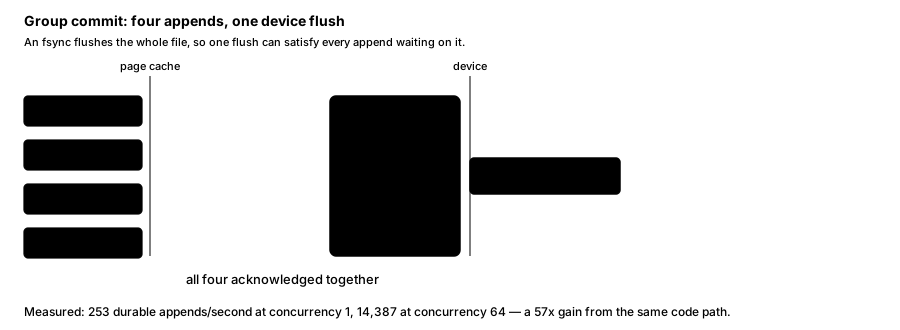
The lock protocol behind that picture — who flushes, and what the others find when they wake:
sequenceDiagram
    participant A as append A
    participant B as append B
    participant C as append C
    participant L as flush lock
    participant D as Device

    A->>L: acquire
    B->>L: (queued)
    C->>L: (queued)
    A->>D: fsync
    D-->>A: durable through offset N
    A->>L: release
    Note over B,C: wake, find their target<br/>already durable,<br/>return without flushing
The full matrix, the regression budget, and the reasoning behind each optimisation are in the performance document.
Configuration
Section titled “Configuration”| Variable | Default | Meaning |
|---|---|---|
FELIX_DURABLE_STORAGE_DIR |
unset | Root directory; setting it enables durable streams |
FELIX_DURABLE_FSYNC_MODE |
periodic |
none | periodic | on_commit |
FELIX_DURABLE_FSYNC_INTERVAL_MS |
250 |
Interval for periodic |
FELIX_DURABLE_SEGMENT_BYTES |
268435456 |
Rollover size |
FELIX_DURABLE_INDEX_SPACING_BYTES |
4096 |
Sparse index interval |
FELIX_DURABLE_MAX_RECORDS_PER_READ |
10000 |
Record cap on one range read |
FELIX_DURABLE_PREALLOCATE |
true |
Reserve segment blocks at creation |
FELIX_DURABLE_VERIFY_ALL_ON_OPEN |
false |
Checksum every segment at startup |
FELIX_DURABLE_REPAIR_CHECKSUM_TAIL |
false |
Truncate a complete trailing record that fails its checksum (see below) |
Invalid combinations fail at startup, not at the first publish.
FELIX_DURABLE_STORAGE_DIR=/var/lib/felix/streams \FELIX_DURABLE_FSYNC_MODE=on_commit \ cargo run --release -p broker --bin felix-brokerObservability
Section titled “Observability”| Metric | Answers |
|---|---|
felix_storage_append_duration_seconds |
how long a durable publish takes end to end |
felix_storage_sync_duration_seconds |
how much of that is the device |
felix_storage_sync_batch_appends |
group-commit fan-in; near 1 under load means no batching |
felix_storage_unsynced_bytes |
data a crash would lose right now |
felix_storage_sync_failures_total |
non-zero means acknowledged durability is in doubt |
felix_storage_recovery_truncated_bytes |
bytes discarded from a torn tail |
The first two together answer the question that actually comes up: is durability the bottleneck? If sync dominates append, the fsync policy is the cost.
See it work
Section titled “See it work”cargo run --release -p broker --bin durable-restart-demoPublishes to one durable and one non-durable stream, drops the broker with no graceful shutdown, boots a second broker over the same directory, and reads both back. It verifies its own claims rather than narrating them, so a regression makes it fail rather than print the wrong numbers.
Limits today
Section titled “Limits today”- No retention.
truncateexists for replication’s benefit; nothing deletes segments on age or size yet. A stream’s retention policy is accepted and recorded, and nothing acts on it. - No tiered storage.
TieredStoreand its companions are declared traits with no implementation. There is no hot/cold split and no cold-tier read path; every read comes from local segments. Sealed segments are immutable and carry a whole-file checksum, and reads already route per segment — so a cold tier slots in at that seam when it is built. - Single node. This page describes one broker’s storage; replication
across brokers is layered on top of it, and
seal’s checksum andread_range’s bounded paging exist to serve that.