
System Design
How the whole system fits together: the design goals, the pieces, and the paths a publish, a subscribe, and a cache request take through them.
Design Principles
Section titled “Design Principles”1. One Core Log, Many Semantics
Section titled “1. One Core Log, Many Semantics”Internally, Felix is built around a single append-only log abstraction. Different external semantics are projections over this core:
- Streams (Pub/Sub): read the log forward, one cursor per subscription
- Caches: read the log through an index of key to latest offset, rebuilt from the log itself
- Queues: read the log through a cursor shared by a consumer group, with acknowledgements and bounded redelivery
All three are built. What each one stores, keeps in memory, and rebuilds from the log — and the test behind every claim about them — is in Projections, which is the page to trust when this one is vaguer.
This reduces operational complexity and consistency bugs compared to running Kafka, Redis, and a queueing system side-by-side. It is also the project’s central bet, so the claim is held to its evidence rather than repeated: scripts/check_doc_evidence.py fails the docs build if a cited test no longer exists.
2. Low-Latency First
Section titled “2. Low-Latency First”Felix prioritizes predictable low latency over maximum batch throughput:
- QUIC transport: Multiplexed, encrypted, congestion-aware
- Optional ephemeral streams: No disk on hot path
- Aggressive backpressure: Bounded memory everywhere
- Leader-based writes: Tunable acknowledgement policies
3. Kubernetes-Native
Section titled “3. Kubernetes-Native”Felix assumes Kubernetes for process lifecycle, identity (ServiceAccounts), networking and service discovery, and failure detection. Felix does not attempt to reimplement scheduling or node membership logic that Kubernetes already provides.
System Architecture
Section titled “System Architecture”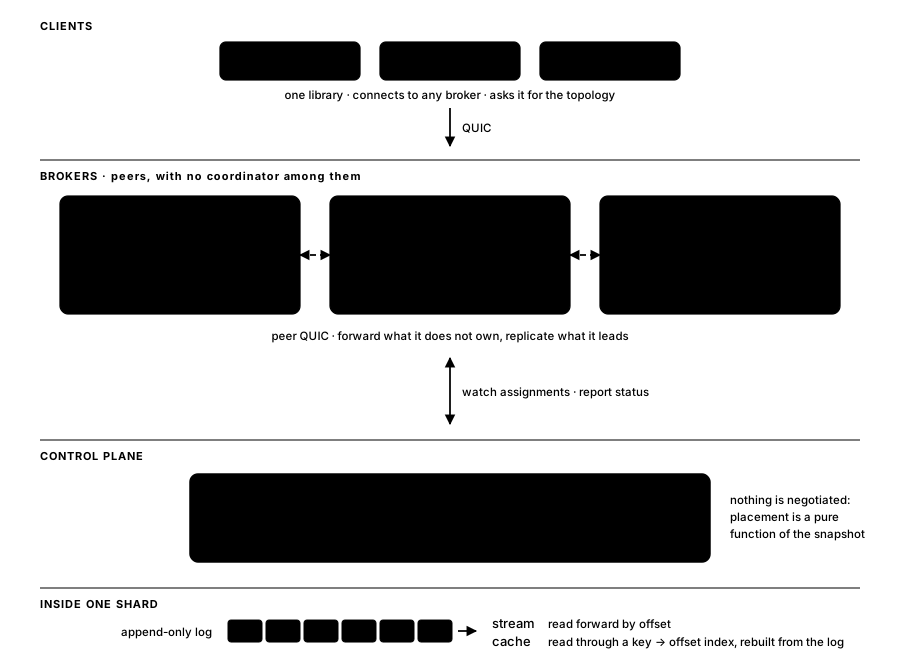
Three things carry most of the design.
Any broker accepts any request. A client connects to whichever broker it can reach and asks it for the topology. If that broker does not lead the shard the request belongs to, it forwards the request to the broker that does and relays the answer — the client is never asked to find the right one first, and never talks to more than one broker for a single request.
Ownership comes from the control plane, and only from there. Every shard of every stream and cache has exactly one leader, chosen by rendezvous hashing over the live nodes. Brokers watch the assignment feed — a snapshot, then a change stream — and never negotiate ownership among themselves.
No consensus protocol runs between brokers. Placement is a pure function of a metadata snapshot, so two control-plane instances reading the same catalog reach the same answer without having to agree on one. Durability across a leader change comes from log shipping and leader leases: per-shard Raft was considered and rejected, for reasons set out in docs/replication-design.md.
That rejection is specific to replicating records. Making the control plane’s own metadata highly available is a separate problem, and Raft is the answer there: the instances embed a Raft group and hold the metadata themselves, with no external database. See Metadata Raft; Postgres remains fully supported for deployments that prefer it.
The control plane is off the data path for reads, subscribes, and Leader publishes: brokers read it in the background and serve from what they already hold.
A Quorum publish is the exception, and a deliberate one. It is released by the shard’s quorum mark, and the leader sends its replica report to the control plane before moving that mark, awaiting the answer — otherwise a leader could tell a client its record is on a majority while the control plane still knows nothing about which replica holds it, and a leader dying in that window is replaced by whichever replica scores highest, possibly the one without the record. So a quorum acknowledgement costs one control-plane round trip, and an unreachable control plane stalls Quorum publishes rather than acknowledging on a report that never landed.
Control plane
Section titled “Control plane”Serves metadata over REST, backed by a Raft group across the instances, by Postgres, or by an in-memory store. It owns tenants, namespaces, streams, caches, the node catalog, and shard assignments, and it runs placement on a timer. Brokers seed from it at startup and gate readiness on that seeding, so a broker does not accept traffic for streams it does not yet know about.
Data plane
Section titled “Data plane”Brokers serve clients over QUIC and reach each other over a separate QUIC endpoint with its own protocol. Each one leads some shards, replicates the ones it leads to followers, forwards what it does not lead, and refuses what it cannot route — a request served locally by a broker that does not own it is exactly the divergence the ownership check exists to prevent.
Data Flow Patterns
Section titled “Data Flow Patterns”Publish/Subscribe Flow
Section titled “Publish/Subscribe Flow”sequenceDiagram
participant P as Publisher
participant B as Broker
participant S1 as Subscriber 1
participant S2 as Subscriber 2
P->>B: Open control stream (QUIC bi)
S1->>B: Open control stream (QUIC bi)
S2->>B: Open control stream (QUIC bi)
S1->>B: Subscribe(tenant, namespace, stream)
B-->>S1: OK
B->>S1: Open event stream (QUIC uni)
S2->>B: Subscribe(tenant, namespace, stream)
B-->>S2: OK
B->>S2: Open event stream (QUIC uni)
loop Publishing
P->>B: Publish(batch of messages)
B-->>P: ACK (optional)
B->>B: Enqueue for fanout
par Fanout to subscribers
B->>S1: Event batch
B->>S2: Event batch
end
end
Key characteristics:
- Publishers use bidirectional control streams for publish requests
- Subscribers get dedicated unidirectional event streams
- Fanout happens independently per subscriber (isolation)
- Batching is time and count-bounded for throughput optimization
Cache Flow
Section titled “Cache Flow”sequenceDiagram
participant C as Client
participant B as Broker
C->>B: Open cache stream pool (N connections)
Note over C,B: M stream workers per connection
par Concurrent requests
C->>B: cache_put(tenant, namespace, cache, key1, value1, ttl)
C->>B: cache_get(tenant, namespace, cache, key2)
C->>B: cache_put(tenant, namespace, cache, key3, value3, ttl)
end
par Concurrent responses
B-->>C: OK (key1)
B-->>C: cache_value(key2, null)
B-->>C: OK (key3)
end
Key characteristics:
- Connection pooling reduces handshake overhead
- Request multiplexing over long-lived streams
- Request IDs for request/response matching
- Sub-millisecond latency at moderate concurrency
Cross-Broker Routing
Section titled “Cross-Broker Routing”When a client reaches a broker that does not lead the target shard:
sequenceDiagram
    participant C as Client
    participant B1 as Broker (ingress)
    participant B2 as Broker (shard owner)

    C->>B1: Publish(stream, key, batch)
    B1->>B1: hash the key, resolve the owner locally
    B1->>B2: AuthorizedForwardPublish(shard, generation, payloads, client credential)
    B2->>B2: check ownership at that generation, verify the credential, then commit
    B2-->>B1: ForwardPublishOk(offsets)
    B1-->>C: Ack
The control plane is not in this picture, and that is the point. Resolving an owner is an atomic load of a routing snapshot the broker already holds — no lock, no network call — because this is the hottest question the broker is asked. The snapshot is refreshed in the background from the assignment feed.
The generation the ingress broker resolved against travels with the request.
The owner compares it against its own and answers a mismatch explicitly in either
direction, so a stale view is a typed answer rather than a write to a shard
somebody has already been given.
Storage Architecture
Section titled “Storage Architecture”Storage is selected per stream. A stream registered with durable: false — the
default — behaves exactly as it always has; durable: true writes every publish
to disk before it is fanned out or acknowledged.
Ephemeral (default)
Section titled “Ephemeral (default)”- In-memory only: No disk writes on hot path
- Bounded buffers: Ring buffers with fixed capacity
- TTL support: Lazy expiration on access
- No persistence: Data lost on restart
Use cases:
- Ultra-low latency workloads
- Development and testing
- Temporary caching
- Non-critical event streams
Durable (durable: true)
Section titled “Durable (durable: true)”- Segmented append-only log: versioned, checksummed segments per stream shard, with sparse offset indexes. Not write-ahead logging — the log is the data, not a journal protecting another structure.
- Configurable fsync:
none,periodic { interval }, oron_commit, which acknowledges only after the record is on the device - Crash recovery: a provably incomplete tail is repaired; anything else fails startup loudly rather than discarding acknowledged records
- Historical replay: paged reads from disk by offset
Retention is implemented and off by default: set
FELIX_DURABLE_RETENTION_BYTES or FELIX_DURABLE_RETENTION_SECONDS and the
oldest segments are discarded, with a resume below the oldest retained offset
answered by a typed error rather than a silent restart at the tail. Unset,
nothing deletes segments and a log grows without bound.
Not yet implemented: snapshots, and tiered storage (#172). Compaction exists, but for the cache rather than for streams — a cache log reclaims superseded and expired records, and a stream log never rewrites a record at all.
See Durable Storage.
Use cases:
- Production event streaming
- Critical message delivery
- Replay and audit trails
Consistency Model
Section titled “Consistency Model”Single node
Section titled “Single node”- Delivery: At-most-once for a plain subscription; at-least-once through a consumer group, which redelivers anything not acknowledged before its visibility timeout
- Ordering: Per-stream ordering preserved per subscriber. For a durable stream, the order on disk is authoritative and cursor replay and live delivery both follow it.
- Durability: Per stream. Ephemeral by default;
durable: truepersists every publish before acknowledging it.
Clustered
Section titled “Clustered”Consistency is declared per stream:
Leader: the leader acknowledges once the record is durable locally. Lowest latency, and the default.Quorum: the leader waits until a majority of the shard’s replicas — itself included — hold the record. A record acknowledged this way survives the loss of its leader.
A leader serves only while it holds a lease on the shards it leads, so a broker that has been superseded stops acknowledging rather than discovering the fact later.
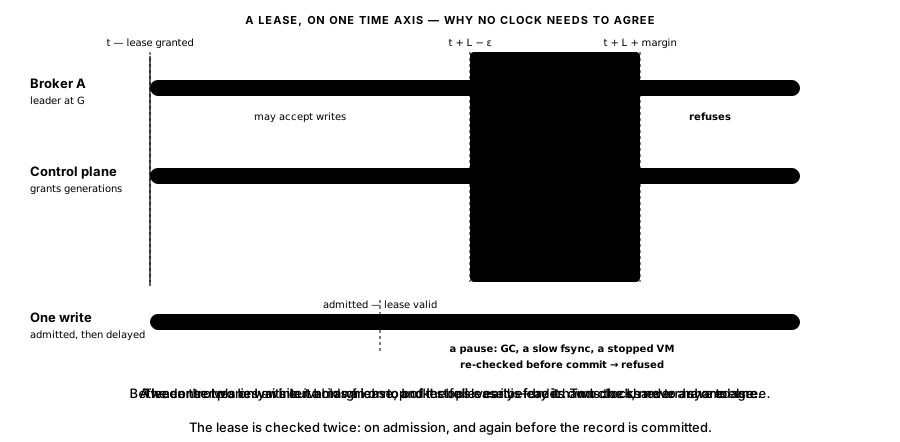
The leader stops ε early by its own clock; the control plane waits out a margin on top of the full lease before handing the shard to anyone else. The gap between those two instants is a safety interval in which no broker believes it is leader, and it is why this works without the two clocks ever agreeing — each only has to measure its own elapsed time.
The lease is checked twice, on admission and again immediately before the record is committed. The second check is not redundant: a full ingress queue, a slow fsync or a stopped VM can take arbitrarily long, and a lease that was valid when the request arrived may have expired by the time the bytes reach the disk. On failover, only a replica that actually holds the log is promoted: a shard whose leader is gone and whose replicas are behind is left unavailable rather than reopened empty, because a silently empty shard is the data loss.
Delivery guarantees:
- At-most-once: a plain subscription, best-effort with no retries
- At-least-once: a consumer group, which redelivers until acknowledged and then dead-letters; or a durable stream replayed from a checkpointed offset
- Exactly-once: not implemented, and not planned — see Semantics
Multi-Region Architecture (Planned)
Section titled “Multi-Region Architecture (Planned)”The target design has Felix enforce regional isolation with explicit bridges:
flowchart LR
    subgraph Region1["Region: US-EAST"]
        B1["Brokers<br/>US-EAST"]
        CONTROLPLANE1["Control Plane<br/>US-EAST"]
    end

    subgraph Region2["Region: EU-WEST"]
        B2["Brokers<br/>EU-WEST"]
        CONTROLPLANE2["Control Plane<br/>EU-WEST"]
    end

    subgraph Bridge["Explicit Bridge"]
        BridgeAgent["Bridge Agent<br/>• Allowlist<br/>• Encryption<br/>• Audit Log"]
    end

    B1 <-->|"Explicit config only"| BridgeAgent
    BridgeAgent <-->|"Explicit config only"| B2

    style Region1 fill:#e1f5ff,stroke:#334155,color:#111827
    style Region2 fill:#fff4e1,stroke:#334155,color:#111827
    style Bridge fill:#ffe1e1,stroke:#334155,color:#111827
Target bridge characteristics (not yet built):
- Explicit Configuration: No implicit data movement
- Stream Allowlist: Only specified streams replicate
- Independent Encryption: Per-region key contexts
- Audit Trail: Complete log of cross-region data movement
None of this has been implemented or audited; do not rely on it for regulatory or compliance purposes until it ships.
Scalability Considerations
Section titled “Scalability Considerations”Vertical Scaling (Single-Node)
Section titled “Vertical Scaling (Single-Node)”- CPU: More cores for parallel stream processing
- Memory: Larger buffers and cache capacity
- Network: Higher bandwidth for fanout
- Measured: hundreds of thousands to millions of msg/s on a single node, depending entirely on payload size and fanout — see Benchmarks rather than any single figure here
Horizontal Scaling (Multi-Node)
Section titled “Horizontal Scaling (Multi-Node)”- Sharding: Partition streams across brokers
- Connection pooling: Reuse connections across shards
- Control plane: REST over Raft, Postgres, or memory; scale by adding instances, since placement is a pure function of the catalog and needs no agreement between them. On the Postgres backend the instances are stateless; on the Raft backend they hold the metadata themselves
- Data plane: many broker nodes for capacity
No cluster-level throughput figure is claimed here: the published benchmarks are single-node, and a multi-node number measured on one machine would say more about the loopback than about Felix.
Next Steps
Section titled “Next Steps”- Components Deep Dive - Detailed component architecture
- Wire Protocol - Protocol specification
- Semantics - Delivery and consistency guarantees
- Performance Tuning - Optimize for your workload