
Cache Features
The Felix cache is a key-value store served over the same QUIC transport and wire protocol as everything else. It exists for the workloads a sidecar Redis usually gets deployed for — sessions, configuration, hot lookups — without running a second system.
Overview
Section titled “Overview”The Felix cache is:
- Key-value store with optional TTL (time-to-live)
- Scoped to
(tenant_id, namespace, cache_name, key) - In-memory for lowest latency, when the broker has no durable storage configured. With
FELIX_DURABLE_STORAGE_DIRthe cache is backed by a log and survives a restart. - Watchable when log-backed: subscribe to changes for one key or key prefix, resume by offset, with loss made loud rather than silent
- Multiplexed over pooled QUIC streams
- Highly concurrent with request pipelining
graph LR
    subgraph Clients
        C1[Client 1]
        C2[Client 2]
        C3[Client 3]
    end

    subgraph Broker["Broker Cache Engine"]
        CM[Cache Manager]
        HM[HashMap Storage]
        TTL[TTL Tracker]
    end

    C1 -->|cache_put/get| CM
    C2 -->|cache_put/get| CM
    C3 -->|cache_put/get| CM

    CM --> HM
    CM --> TTL

    style CM fill:#fff3e0,stroke:#334155,color:#111827
    style HM fill:#e3f2fd,stroke:#334155,color:#111827
    style TTL fill:#f3e5f5,stroke:#334155,color:#111827
Core Features
Section titled “Core Features”1. Low-Latency Operations
Section titled “1. Low-Latency Operations”Felix cache is optimized for microsecond-level latency:
Localhost performance (concurrency=32):
| Operation | Payload | p50 Latency | p99 Latency | Throughput |
|---|---|---|---|---|
| put | 0 B | 158 µs | 350 µs | 184k ops/sec |
| put | 256 B | 179 µs | 380 µs | 155k ops/sec |
| put | 4 KB | 260 µs | 480 µs | 78k ops/sec |
| get (hit) | 256 B | 177 µs | 360 µs | 166k ops/sec |
| get (miss) | - | 165 µs | 340 µs | 179k ops/sec |
Methodology and current figures live in Benchmarks. Compared to a plain-TCP cache, Felix pays some latency for always-on TLS and QUIC framing; what it buys is multiplexing, per-stream flow control, and one system instead of two.
2. Time-to-Live (TTL)
Section titled “2. Time-to-Live (TTL)”Store entries with automatic expiration:
// Store session with 1-hour TTLclient.cache_put(    "acme",    "prod",    "sessions",    "user-abc",    session_data,    Some(3600_000)  // 60 minutes in milliseconds).await?;
// After 1 hour, entry automatically expirestokio::time::sleep(Duration::from_secs(3601)).await;
// Returns None (expired)assert_eq!(    client.cache_get("acme", "prod", "sessions", "user-abc").await?,    None);
TTL semantics:
- Countdown starts: When
cache_putcompletes - Expiration checking: Lazy (on access)
- Precision: Best-effort, typically < 100 ms variance
- Updates: Each
cache_putresets TTL
Common TTL patterns:
// Short-lived session (5 minutes)client    .cache_put("acme", "prod", "sessions", key, data, Some(300_000))    .await?;
// Medium-lived cache (1 hour)client    .cache_put("acme", "prod", "user-profiles", key, data, Some(3600_000))    .await?;
// Long-lived config (24 hours)client    .cache_put("acme", "prod", "config", key, data, Some(86400_000))    .await?;
// Permanent (until restart or eviction)client    .cache_put("acme", "prod", "static-data", key, data, None)    .await?;
3. Namespace Scoping
Section titled “3. Namespace Scoping”Cache entries are scoped to prevent collisions:
Scope hierarchy:
(tenant_id, namespace, cache_name, key)Example:
// These are completely independent entriesclient.cache_put_scoped("acme", "prod", "sessions", "user-123", data1, ttl).await?;client.cache_put_scoped("acme", "staging", "sessions", "user-123", data2, ttl).await?;client.cache_put_scoped("acme", "prod", "profiles", "user-123", data3, ttl).await?;client.cache_put_scoped("other-tenant", "prod", "sessions", "user-123", data4, ttl).await?;Benefits:
- Isolation: Tenants can’t access each other’s data
- Organization: Group related entries by cache name
- Flexibility: Different TTLs/eviction per cache
- Multi-tenancy: Safe shared infrastructure
4. Request Pipelining
Section titled “4. Request Pipelining”Send multiple cache requests without waiting for responses:
use futures::future::join_all;
// Issue 10 concurrent getslet futures = (0..10).map(|i| {    let key = format!("key-{}", i);    client.cache_get("acme", "prod", "config", &key)});
// Await all responseslet results: Vec<Option<Vec<u8>>> = join_all(futures).await    .into_iter()    .collect::<Result<Vec<_>>>()?;
Ten sequential gets cost ten round trips; ten pipelined gets cost roughly
one. It works because each request carries a request_id, the broker may
answer out of order, and the client correlates replies — so nothing waits on
anything it doesn’t have to.
5. Stream Pooling
Section titled “5. Stream Pooling”Felix uses stream pooling for high-concurrency cache workloads:
# Client configurationcache_conn_pool: 8 # QUIC connectionscache_streams_per_conn: 4 # Streams per connection# Total concurrent operations: 8 × 4 = 32Why pooling matters:
Without pooling (single stream):
- All requests serialize on one stream
- HOL blocking if any request is slow
- Limited throughput
With pooling, requests spread across streams with independent flow control, so concurrency scales until the transport or broker saturates — not a fixed multiplier. Measure your own workload’s shape; the concurrency sweep in Benchmarks is the reference point.
6. Consistency Model
Section titled “6. Consistency Model”Felix cache provides read-your-writes consistency:
// Put valueuse bytes::Bytes;client    .cache_put("acme", "prod", "data", "key", Bytes::from_static(b"value-1"), None)    .await?;
// Immediately read (same client)assert_eq!(    client.cache_get("acme", "prod", "data", "key").await?,    Some(b"value-1".to_vec()));
Consistency guarantees:
- Read-your-writes: Client sees its own writes immediately
- Monotonic reads: Never see older value after newer one (same session)
- Eventual consistency: All clients eventually see latest value
- No torn writes: Writes are atomic
No linearizability: Concurrent writes from different clients may see inconsistent ordering.
sequenceDiagram
    participant C1 as Client 1
    participant C2 as Client 2
    participant B as Broker

    par Concurrent writes
        C1->>B: put(key=X, value=A)
    and
        C2->>B: put(key=X, value=B)
    end

    Note over B: Last write wins (order undefined)

    C1->>B: get(key=X)
    B-->>C1: value=A or B (undefined)
7. Keyed Watch
Section titled “7. Keyed Watch”A log-backed cache is not just readable — it is subscribable. watch_cache
delivers every applied write for one key or key prefix, in the shard’s write
order, each change carrying the cache-log offset that makes it resumable:
use felix_client::{CacheWatchFilter, CacheWatchItem};
// Current changes only, from now onlet mut watch = client    .watch_cache("acme", "prod", "config", CacheWatchFilter::Key("app-settings".into()), None)    .await?;
while let Some(item) = watch.recv().await {    match item {        CacheWatchItem::Change(change) => match change.value {            Some(value) => reload_config(&value),           // put            None => clear_config(),                          // delete        },        CacheWatchItem::Lagged { resume_from } => {            // The watch fell behind and was ended. Re-watching from            // `resume_from` replays everything missed — gapless.            break;        }    }}
A prefix watch works the same way — CacheWatchFilter::Prefix("user:".into())
sees every key under user: — and an empty prefix is every key in the shard.
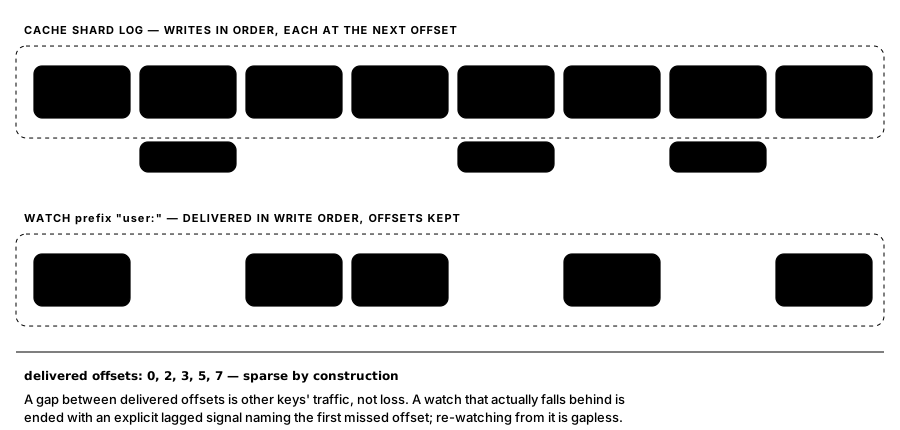
Resume by offset. Pass Some(offset) to resume at the first change not yet
seen; the broker replays [offset, tail) from the cache’s log before live
delivery, joined with no gap and no duplicate. An application checkpoints
change.offset + 1 exactly as a stream subscriber does.
Compaction is never a silent gap. The cache’s log compacts, so a
long-disconnected watcher can name an offset that no longer exists. The broker
answers with resnapshot() == true and each matching key’s current value,
then live changes — the same snapshot-plus-changes contract etcd answers a
compacted watch revision with.
Loss is loud. A filtered watch cannot detect a drop from an offset jump
(other keys’ writes make offsets sparse), so a watch that falls behind is ended
with Lagged { resume_from } rather than quietly thinned. Re-watching from
resume_from is gapless.
sequenceDiagram
    participant App as Application
    participant B as Broker
    participant L as Cache log
    App->>B: watch_cache(key "app-settings", from_offset 41)
    Note over B: Registers the watcher before reading the tail,<br/>so no write can land between the two unseen
    B->>L: read tail (= 57) and [41, 57)
    B-->>App: changes 41..57 that match (replay)
    B-->>App: change 57, 58, ... (live)
    Note over App: checkpoint offset + 1 after each change
Retained delivery: current state first. A watch can start from the state
instead of from now — MQTT’s retained message, and the primitive presence and
state-sync applications are built on. watch_cache_retained delivers each
matching key’s current value (at the offset of the write that produced it),
then live changes; a client joins and immediately holds the roster:
let mut watch = client    .watch_cache_retained("acme", "prod", "presence", CacheWatchFilter::Prefix("room:7:".into()))    .await?;
// Exactly this many values are the current state — 0 means the room is// empty, which is an answer, not a silence.let joining = watch.retained_count().expect("a retained watch reports its count");
let mut roster = std::collections::HashMap::new();while let Some(item) = watch.recv().await {    if let CacheWatchItem::Change(change) = item {        match change.value {            Some(value) => roster.insert(change.key, value),            None => roster.remove(&change.key),        };        // After `joining` changes the roster is complete; everything further        // is someone arriving or leaving, live.    }}
Retained and from_offset are mutually exclusive — a resume already replays
the state a retained start shortcuts. And the two compose with everything
above: a retained watch that later falls behind still lags loudly, and a key
whose newest write races past the join arrives as the first live change
instead of in the state, folding to the same result.
TTL expiry delivers no event — expiry is lazy and appends nothing to the log —
but every put carries its expires_at_millis, so a watcher that mirrors the
cache can expire entries itself.
The features are negotiated (FEATURE_CACHE_WATCH, with retained delivery as
its own FEATURE_CACHE_WATCH_RETAINED bit) and advertised only by brokers
whose cache is log-backed: an in-memory cache has no offsets to anchor resume,
duplicate detection, or the lag signal to. See the
wire protocol for the message shapes.
8. Counters
Section titled “8. Counters”A counter as a log semantic: counter_add appends a signed delta, the broker
folds the running sum, and the answer is the sum including your delta — so
incrementing and learning where you stand is one round trip:
// One round trip: apply the delta and learn the result.let hits = client.counter_add("acme", "prod", "limits", "user:42:reqs", 1).await?;if hits > LIMIT {    return Err(RateLimited);}
// Point read; None means never written, which is not the same as zero.let views = client.counter_get("acme", "prod", "metrics", "page:home").await?;
Counters are scoped and routed exactly like cache keys — same cache scope, same key-to-shard hash, same owner — but live beside the cache, not in it: a counter and a cache value may share a key and are unrelated, and a cache watch does not see counter changes.
The sum is durable and replicated: it survives a restart (rebuilt by folding
the log), compaction (applied deltas collapse into a checkpoint without the
sum or the offsets moving), and leader failover (the counter log ships with
its cache shard, so the promoted replica folds the true sum and keeps
counting). Negotiated as FEATURE_COUNTERS, durable brokers only.
9. Composed semantics: which flow for which problem
Section titled “9. Composed semantics: which flow for which problem”The cache’s semantics are readings of one log, so they compose — and each composition is the primitive a class of application is usually hand-built from:
| You are building | Reach for | Why this shape |
|---|---|---|
| Config push, feature flags, cache invalidation | Keyed watch on the config key or prefix | Every instance learns of the change the moment it lands; the offset makes reconnects gapless instead of “poll and hope” |
| Presence, lobbies, collaborative state | Retained watch on a prefix | Join and immediately hold the roster, then stay current; retained_count tells you the exact moment your state is complete, and an empty room is a definite zero |
| A read-heavy dashboard over changing state | Retained watch, materialized locally | Current values first, then only the changes — no re-fetch loop, and a lag is signalled loudly rather than shown as stale data |
| Rate limiting, quotas, usage metering | Counter per principal | Increment-and-read in one round trip against the shard’s owner, durable across restart and failover — not a racy get-modify-put |
| Live tallies (votes, likes, inventory deltas) | Counter, read by pollers or fronted by a put | Deltas fold server-side; publish the folded sum into a watched cache key when watchers need push instead of poll |
10. Eviction (in-memory only: best-effort)
Section titled “10. Eviction (in-memory only: best-effort)”The in-memory backend evicts opportunistically under memory pressure — no guaranteed LRU or LFU, so don’t rely on a specific eviction order. The log-backed cache does not evict at all; it compacts. Configurable eviction policies are a possible future, not a present.
API Reference
Section titled “API Reference”cache_put
Section titled “cache_put”Store a key-value pair with optional TTL.
Signature:
async fn cache_put( &self, tenant_id: &str, namespace: &str, cache: &str, key: &str, value: Bytes, ttl_ms: Option<u64>) -> Result<()>Parameters:
tenant_id: Tenant identifiernamespace: Namespace within the tenantcache: Cache name (e.g., “sessions”, “config”)key: Cache key (arbitrary string)value: Value to store (binary data)ttl_ms: Optional TTL in milliseconds (None = no expiration)
Returns: Ok(()) on success, error on failure
Example:
use bytes::Bytes;
// Store with 30-minute TTLclient.cache_put(    "acme",    "prod",    "sessions",    "session-xyz",    Bytes::from(session_data),    Some(1800_000)).await?;
cache_get
Section titled “cache_get”Retrieve a value from the cache.
Signature:
async fn cache_get( &self, tenant_id: &str, namespace: &str, cache: &str, key: &str) -> Result<Option<Vec<u8>>>Parameters:
tenant_id: Tenant identifiernamespace: Namespace within the tenantcache: Cache namekey: Cache key to retrieve
Returns:
Ok(Some(value)): Key found, value returnedOk(None): Key not found or expiredErr(e): Operation failed
Example:
match client.cache_get("acme", "prod", "sessions", "session-xyz").await? { Some(data) => { let session: Session = deserialize(&data)?; // Use session } None => { return Err("Session expired or not found"); }}cache_delete
Section titled “cache_delete”Remove a key, reporting the value it held.
Signature:
async fn cache_delete( &self, tenant_id: &str, namespace: &str, cache: &str, key: &str) -> Result<Option<Bytes>>Returns:
Ok(Some(value)): The key was there; this is what was removedOk(None): The key was not there — an answer, not an errorErr(e): Operation failed, or the broker predatesFEATURE_CACHE_DELETE
watch_cache
Section titled “watch_cache”Subscribe to changes for one key or key prefix. See Keyed Watch.
Signature:
async fn watch_cache( &self, tenant_id: &str, namespace: &str, cache: &str, filter: CacheWatchFilter, // Key(String) or Prefix(String) from_offset: Option<u64> // None = from now; Some(n) = resume at n) -> Result<CacheWatch>Returns: a CacheWatch whose recv() yields CacheWatchItem::Change
(key, optional value, offset, expiry) and, if the watch falls behind,
CacheWatchItem::Lagged { resume_from } before ending. resnapshot() reports
whether a resume began from current values because compaction collapsed the
requested history. Fails without sending anything when the broker did not
advertise FEATURE_CACHE_WATCH.
Use Cases
Section titled “Use Cases”1. Session Management
Section titled “1. Session Management”Store user sessions with automatic expiration:
struct SessionStore {    client: Arc<Client>,}
impl SessionStore {    async fn create_session(&self, user_id: &str) -> Result<String> {        let session_id = generate_session_id();        let session = Session {            user_id: user_id.to_string(),            created_at: Utc::now(),            expires_at: Utc::now() + Duration::minutes(30),        };
        // Store with 30-minute TTL        use bytes::Bytes;        self.client            .cache_put(                "acme",                "prod",                "sessions",                &session_id,                Bytes::from(serialize(&session)?),                Some(1800_000),            )            .await?;
        Ok(session_id)    }
    async fn get_session(&self, session_id: &str) -> Result<Option<Session>> {        match self            .client            .cache_get("acme", "prod", "sessions", session_id)            .await?        {            Some(data) => Ok(Some(deserialize(&data)?)),            None => Ok(None),        }    }
    async fn extend_session(&self, session_id: &str) -> Result<()> {        if let Some(mut session) = self.get_session(session_id).await? {            session.expires_at = Utc::now() + Duration::minutes(30);            use bytes::Bytes;            self.client                .cache_put(                    "acme",                    "prod",                    "sessions",                    session_id,                    Bytes::from(serialize(&session)?),                    Some(1800_000),                )                .await?;        }        Ok(())    }}
2. Configuration Cache
Section titled “2. Configuration Cache”Cache application configuration with refresh:
struct ConfigCache {    client: Arc<Client>,}
impl ConfigCache {    async fn get_config(&self, key: &str) -> Result<Config> {        // Try cache first        if let Some(data) = self            .client            .cache_get("acme", "prod", "config", key)            .await?        {            return Ok(deserialize(&data)?);        }
        // Cache miss: load from database        let config = self.load_from_db(key).await?;
        // Store in cache with 1-hour TTL        use bytes::Bytes;        self.client            .cache_put(                "acme",                "prod",                "config",                key,                Bytes::from(serialize(&config)?),                Some(3600_000),            )            .await?;
        Ok(config)    }
    async fn update_config(&self, key: &str, config: &Config) -> Result<()> {        // Update database        self.save_to_db(key, config).await?;
        // Write through to the cache. Every watcher of this key is notified        // with the new value — no separate invalidation channel needed.        use bytes::Bytes;        self.client            .cache_put(                "acme",                "prod",                "config",                key,                Bytes::from(serialize(config)?),                Some(3600_000),            )            .await?;
        Ok(())    }}
3. Rate Limiting
Section titled “3. Rate Limiting”Simple rate limiting with TTL:
struct RateLimiter {    client: Arc<Client>,    limit: u32,    window_ms: u64,}
impl RateLimiter {    async fn check_rate_limit(&self, user_id: &str) -> Result<bool> {        let key = format!("rate-limit:{}", user_id);
        // Try to get current count        let count = match self            .client            .cache_get("acme", "prod", "rate-limits", &key)            .await?        {            Some(data) => u32::from_be_bytes(data.try_into().unwrap()),            None => 0,        };
        if count >= self.limit {            return Ok(false);  // Rate limit exceeded        }
        // Increment count        let new_count = count + 1;        use bytes::Bytes;        self.client            .cache_put(                "acme",                "prod",                "rate-limits",                &key,                Bytes::from(new_count.to_be_bytes()),                Some(self.window_ms),            )            .await?;
Ok(true) // Allow request }}Performance Tuning
Section titled “Performance Tuning”Client Configuration
Section titled “Client Configuration”Latency-optimized (low concurrency):
let quinn = quinn::ClientConfig::with_platform_verifier();let config = ClientConfig { cache_conn_pool: 2, cache_streams_per_conn: 2, ..ClientConfig::optimized_defaults(quinn)};Throughput-optimized (high concurrency):
let quinn = quinn::ClientConfig::with_platform_verifier();let config = ClientConfig { cache_conn_pool: 16, cache_streams_per_conn: 8, ..ClientConfig::optimized_defaults(quinn)};Broker Configuration
Section titled “Broker Configuration”# QUIC flow control (see the environment variable reference for the# FELIX_CACHE_* names and defaults)cache_conn_recv_window: 268435456 # 256 MiB per connectioncache_stream_recv_window: 67108864 # 64 MiB per streamcache_send_window: 268435456 # Send windowLimitations and Planned Features
Section titled “Limitations and Planned Features”Current limitations
Section titled “Current limitations”- No atomic operations: no compare-and-swap, no increment
- No multi-key operations: no transactions
- Best-effort eviction in the in-memory backend: no guaranteed LRU or LFU. The log-backed cache does not evict at all — it compacts.
- A prefix watch reads one shard: keys sharing a prefix hash to different shards, so watching a whole multi-shard cache means one
watch_cache_shardper shard, and nothing opens them for you yet the waysubscribe_shardeddoes for streams - No declared consistency level: a write is acknowledged by the shard’s leader, so losing that leader between the acknowledgement and replication loses the write. A stream can ask for
Quorum; a cache cannot.
What used to be listed here and no longer applies: the cache persists across a
restart when the broker has durable storage, it is routed to a single owner per
key so two brokers cannot hold different values, its shards are replicated,
cache_delete is on the wire, and “no cache invalidation broadcast” — a keyed
watch is exactly that notification, with offsets instead of best effort.
Planned Features
Section titled “Planned Features”Atomic operations:
// Compare-and-swapclient.cache_cas( "locks", "resource-a", expected_value, new_value).await?;Increment shipped as counters — a fold over the log rather than an operation on a cache value, which is why it survives failover. Compare-and-swap remains future.
Multi-key operations:
// Batch getlet keys = vec!["key1", "key2", "key3"];let values = client.cache_get_batch("data", &keys).await?;
// Transactionclient.cache_transaction()    .put("accounts", "alice", decrease(100))    .put("accounts", "bob", increase(100))    .commit()    .await?;
Watch-and-notify and explicit delete used to be listed here; both shipped — see Keyed Watch and cache_delete.
One design rule worth keeping
Section titled “One design rule worth keeping”Treat the cache as acceleration, not as the source of truth: design the read path to fall back to wherever the data really lives. That keeps a miss, an eviction, or a broker restart a performance event instead of a correctness event — and it is why the in-memory cache’s best-effort nature is acceptable at all. (For state the cache is the truth of — presence, rosters, counters — use the log-backed cache with watches and counters, which is built for exactly that.)