
Felix Durable Segment Format (v1)
This document defines the on-disk representation of a durable Felix stream. It is
the source of truth for anyone reading, writing, repairing, or replicating
segment files, and it is intentionally independent of felix-wire: network
framing is allowed to change shape for latency reasons, while bytes already on
disk must stay readable by every later build.
Implementation:
crates/felix-storage/src/segment/format.rs.
The two must move together — a change to one without the other is a bug.
This page is the byte layout. For how those bytes are produced and consumed over time — appending, the sparse index, sealing, rollover and retention — see Durable Storage, which walks both through animated diagrams.
- Versioned. A reader that does not understand a file says so instead of guessing.
- Self-validating. Every record carries a checksum over its own header and payload, so bit rot and torn writes are detected on read, not inferred.
- Skippable. The next record’s position is derivable without decoding the current one’s payload, which is what makes index rebuilds and recovery scans cheap.
- Bounded. No length read from disk is used to size an allocation before it has been range-checked.
Conventions
Section titled “Conventions”- All integers are big-endian, matching
felix-wire. - Offsets are logical: a
u64that is stable for the life of a record and independent of where it lands in a file. - A segment is one file of records. A shard is a directory of segments plus their indexes.
Magic numbers
Section titled “Magic numbers”Both file kinds start with a four-byte ASCII magic sharing the prefix FLS —
FeLix Segment — with the last byte naming the kind:
| Magic | ASCII | Expands to | File |
|---|---|---|---|
0x464C5347 |
FLSG |
Felix Segment | segment data (*.log) |
0x464C5349 |
FLSI |
Felix Segment Index | sparse offset index (*.index) |
They are deliberately distinct from felix-wire’s frame magic 0x464C5831
(FLX1): storage bytes and network bytes are separate formats with separate
versioning, and a file that turned up on a socket — or a frame that turned up in
a segment — should be rejected on its first four bytes rather than misparsed.
Directory layout
Section titled “Directory layout”<root>/ acme_default_orders_0-0d3aed4b998d2798/ ← one directory per stream shard 00000000000000000000.log ← segment data 00000000000000000000.index ← sparse offset index 00000000000000000001.log 00000000000000000001.indexThe directory name is a readable rendering of the ShardKey plus an FNV-1a hash
of the exact key. The readable part is lossy — anything outside [A-Za-z0-9-]
becomes _, and components are truncated — so the hash is what guarantees
uniqueness. Dots are excluded deliberately: with no dots in the name, a
component like .. is not merely escaped but unrepresentable.
File names are zero-padded to 20 digits so lexicographic and numeric order agree. Recovery still parses the number and sorts on it rather than trusting directory iteration order, which is filesystem-defined.
Segment file
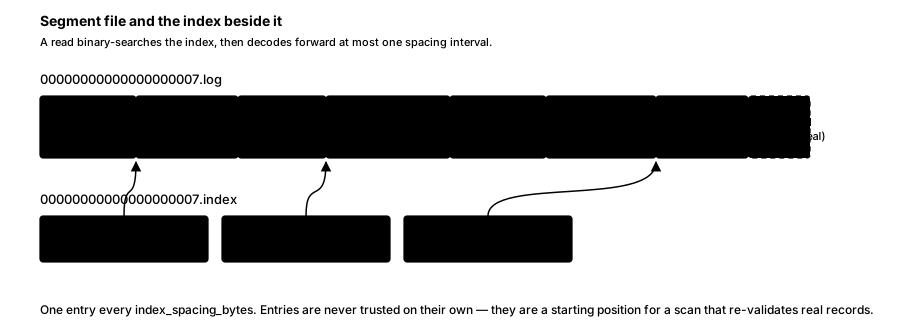
Section titled “Segment file”A 32-byte header, then records back to back, with a sparse index in a companion file:
Segment header (32 bytes)
Section titled “Segment header (32 bytes)”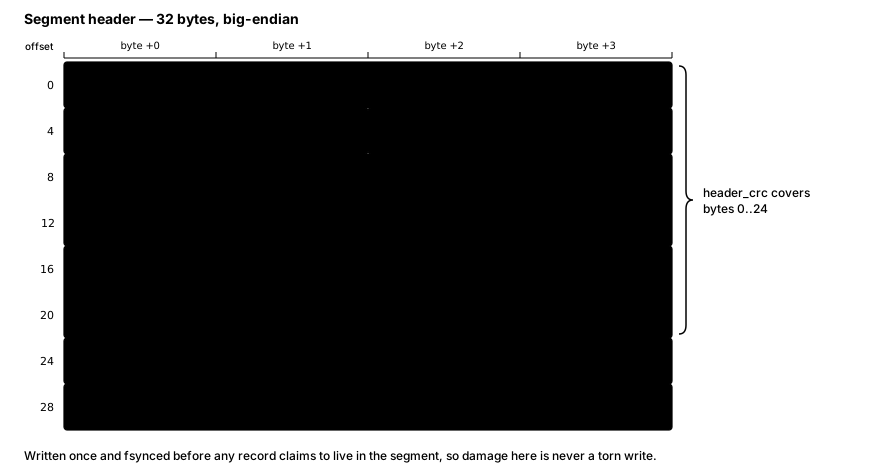
| Offset | Size | Field | Value |
|---|---|---|---|
| 0 | 4 | magic |
0x464C5347 ("FLSG") |
| 4 | 2 | version |
1 |
| 6 | 2 | flags |
0; any other value is rejected |
| 8 | 8 | base_offset |
logical offset of this segment’s first record |
| 16 | 8 | created_at_micros |
wall clock at creation, informational |
| 24 | 4 | header_crc |
CRC-32 (IEEE) over bytes 0..24 |
| 28 | 4 | reserved |
0 |
The header is written once and fsynced before any record claims to live in the segment, so damage here is never a torn write — it is always an error.
Record
Section titled “Record”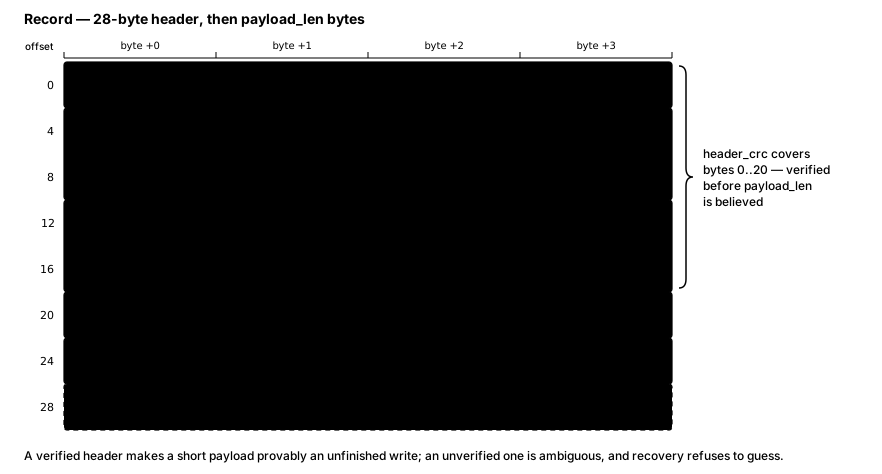
| Offset | Size | Field | Notes |
|---|---|---|---|
| 0 | 4 | payload_len |
≤ MAX_PAYLOAD_BYTES (64 MiB) |
| 4 | 8 | offset |
logical offset; ascends by exactly 1 within a segment |
| 12 | 8 | timestamp_micros |
publish time |
| 20 | 4 | checksum |
CRC-32 over bytes 0..20 followed by the payload |
| 24 | n | payload |
opaque bytes |
payload_len comes first and is covered by the checksum, so a reader can step to
the next record with position + 24 + payload_len without touching payload
bytes. That property is what makes the index rebuild and the recovery scan cost
proportional to record count rather than to bytes decoded.
The checksum covers the header prefix as well as the payload, so a corrupted offset or timestamp is caught by the same check as a corrupted payload.
Index file
Section titled “Index file”Index files accelerate reads and are never trusted. Every entry is used only as a starting position for a scan that re-validates real records, and any index that fails to load — missing, short, wrong generation, garbage — is rebuilt from its segment. Consequently they carry no checksums.
Index header (24 bytes)
Section titled “Index header (24 bytes)”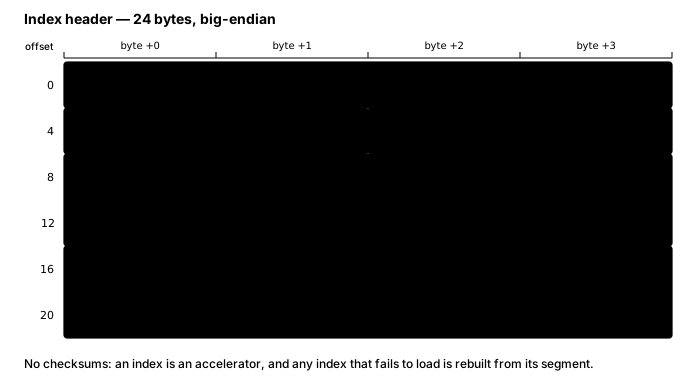
| Offset | Size | Field | Value |
|---|---|---|---|
| 0 | 4 | magic |
0x464C5349 ("FLSI") |
| 4 | 2 | version |
1 |
| 6 | 2 | flags |
0 |
| 8 | 8 | base_offset |
must equal the segment’s base_offset |
| 16 | 8 | reserved |
0 |
Index entry (16 bytes)
Section titled “Index entry (16 bytes)”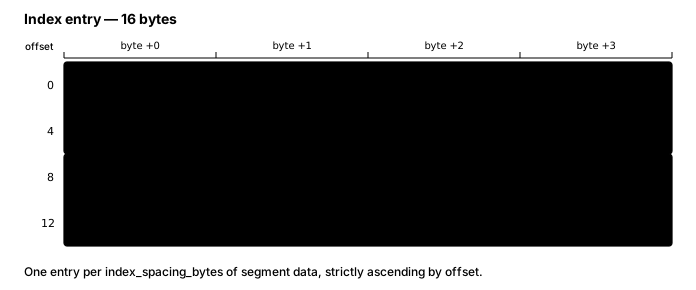
| Offset | Size | Field |
|---|---|---|
| 0 | 8 | offset |
| 8 | 8 | position — byte position of that record in the segment |
Entries are emitted for the segment’s first record and thereafter every
index_spacing_bytes of segment data. They are strictly ascending by offset,
which is what seek_position’s binary search relies on.
A torn final entry — the signature of a crash mid-append — is tolerated on load: the file is read up to the last whole entry.
Compatibility and corruption behaviour
Section titled “Compatibility and corruption behaviour”| Condition | Behaviour |
|---|---|
Unknown magic |
Reject: CorruptionKind::SegmentMagic / IndexMagic |
Unknown version |
Reject: SegmentVersion / IndexVersion. Never “best effort” |
Non-zero flags |
Reject: SegmentFlags. Unknown bits may change the layout behind them, so they are not masked off |
| Bad header CRC | Reject: SegmentHeaderChecksum |
| Short read | Truncated { needed, available } — the one shape recovery may repair |
| Bad record CRC | RecordChecksum |
payload_len over the limit |
RecordTooLarge, raised before any allocation |
| Offset gap within a segment | OffsetOutOfOrder |
Every error carries a CorruptionSite naming the shard, segment id and byte
position, because “corruption detected” is not enough to act on at 3am.
What recovery may repair
Section titled “What recovery may repair”Recovery truncates only damage confined to the end of the newest segment, because only there can a record have been mid-write when the process died:
- A
Truncatedfailure is always repairable. - A
RecordChecksumorOffsetOutOfOrderfailure is repairable only when the record’s claimed extent reaches end of file — that is, when nothing follows it. If committed bytes exist beyond the damage, dropping it would open a gap, so it is an error instead. - A
RecordTooLargefailure is repairable only when the record it claims could not fit in the file, which is the signature of a half-written header. - Segment-header damage is never repairable.
The full rules live in is_repairable_tail in
segment/reader.rs.
Golden vectors
Section titled “Golden vectors”format.rs pins exact bytes for a segment header and a record. Changing either
is a format change: bump FORMAT_VERSION, update this document, and state the
migration path.
SegmentHeader::new(base_offset = 1, created_at_micros = 2):  46 4C 53 47  00 01  00 00  00 00 00 00 00 00 00 01  00 00 00 00 00 00 00 02  D9 5F 63 18  00 00 00 00
encode_record(offset = 7, timestamp = 9, payload = "hi"):  00 00 00 02  00 00 00 00 00 00 00 07  00 00 00 00 00 00 00 09  63 3D A1 4E  68 69
Versioning policy
Section titled “Versioning policy”FORMAT_VERSION is a single number covering both the segment and index layouts.
- Additive changes that keep existing readers correct — new
flagsbits with strictly appended data — still require a version bump, because current readers reject unknown flags rather than skipping them. That is deliberate: silently ignoring a bit that changes the meaning of following bytes is how formats become unreadable. - Any change to a field’s position, width, or meaning requires a bump and an explicit migration path. Segments already on disk are not rewritable in place.
Limits
Section titled “Limits”| Limit | Value | Why |
|---|---|---|
MAX_PAYLOAD_BYTES |
64 MiB | Bounds the allocation a corrupt length field can request |
| Max records per segment | u64 offsets, so effectively unbounded |
Rollover is driven by size, not count |
| Oversized records | A record larger than segment_size_bytes is written to an otherwise-empty segment of its own |
Splitting a record across segments would break the “offsets are contiguous within a segment” invariant that recovery depends on |