
Why Felix?
Most services end up needing three things at once: a record of what happened, the newest value for a key, and a way to hand work to whoever can do it. Felix is one system that does all three, because all three turn out to be the same thing read three different ways.
This page is the plain-language version. It assumes you have never read anything else here.
The problem: one job, three systems
Section titled “The problem: one job, three systems”Take an order service. It needs to:
- keep a record of what happened — order placed, paid, shipped, refunded — so other services can react to each event, and so you can replay the sequence later;
- answer “what is order 42 right now?” without walking that whole history;
- hand out work — send the receipt, charge the card — so that each job goes to exactly one worker and comes back if that worker dies.
Today that usually means three systems. Kafka or Redpanda for the record of what happened. Redis for the current value. NATS JetStream or RabbitMQ for the work.
All three are good at their job. Kafka holds years of history and replays it. Redis answers in microseconds and has data structures Felix does not have. JetStream and RabbitMQ have routing and delivery features built over a decade of people needing them. Nothing below is an argument that they are bad.
The argument is about what it costs to run all three.
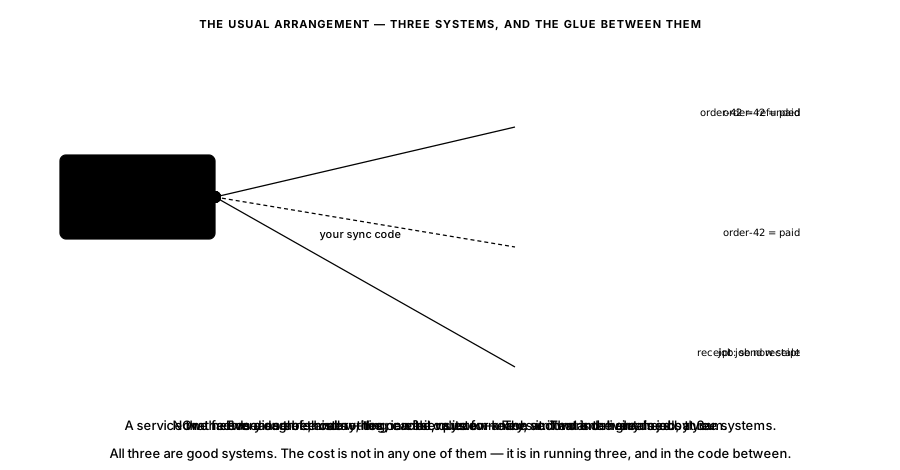
Three deployments to install, upgrade and patch. Three security models, so an identity has to be granted access three times, three different ways. Three replication models, three ways for a node to fail, and three different answers to “is it safe to restart this one.” Three sets of operational knowledge, which in practice means three sets of habits your team has to build before anything is routine.
And then the part nobody writes down: the glue. When an order is paid, that fact has to reach both the log and the cache. That is two writes, and either can fail on its own. When the second one fails, the log says refunded and the cache says paid — and neither system is wrong from where it sits. Neither can even detect it. Only your code knows they were supposed to agree, which means only your code can notice, and only if you wrote that part.
What Felix does differently
Section titled “What Felix does differently”Felix stores one thing: an append-only log. A list of records where writes only ever land at the end, and nothing already written is ever changed.
Stream, cache and queue are not three features built on top of that log. They are three ways of reading it.
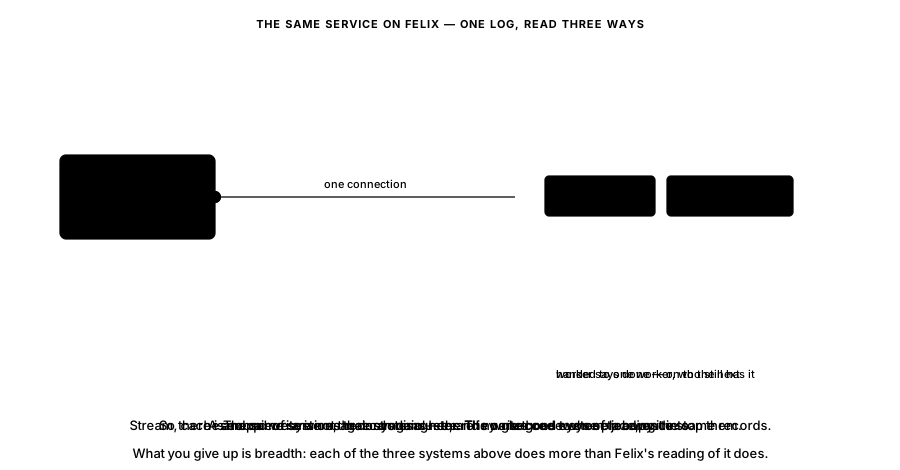
The write happens once. There is no second system to copy it into, so there is no pair of systems that can disagree, and no glue whose job was to stop them.
Why one log can do all three
Section titled “Why one log can do all three”This is the whole idea, and it is simpler than it sounds.
Picture the records in a line, oldest on the left. A new write is added on the right. Nothing already in the line ever changes.
Now put markers under that line. A marker is just a position: this is the record I am looking at.
- A stream is a marker that walks forward over every record, in the order they were written. That is all a subscriber is — a position that keeps moving right.
- A cache is not one marker. It is one marker per key, and each one sits
on the newest record carrying its own key. Asking for the current value of
order-42means following that key’s marker and reading what it points at. The older records for that key are still in the line; the marker has just moved past them. - A queue is a marker shared by a group of workers that only moves when someone says a record is finished. That is why it trails behind the stream: it is not measuring what has been written, it is measuring what has been done.
Two limits are worth knowing before you picture this working at scale. A subscriber that falls too far behind has records dropped rather than buffered for ever, and it is told that it happened — good for a live feed, wrong for anything that must see every record without checking. And a group of workers reads one shard: if you split a stream across several, each shard gets its own group, and dividing the work between them is yours to arrange.
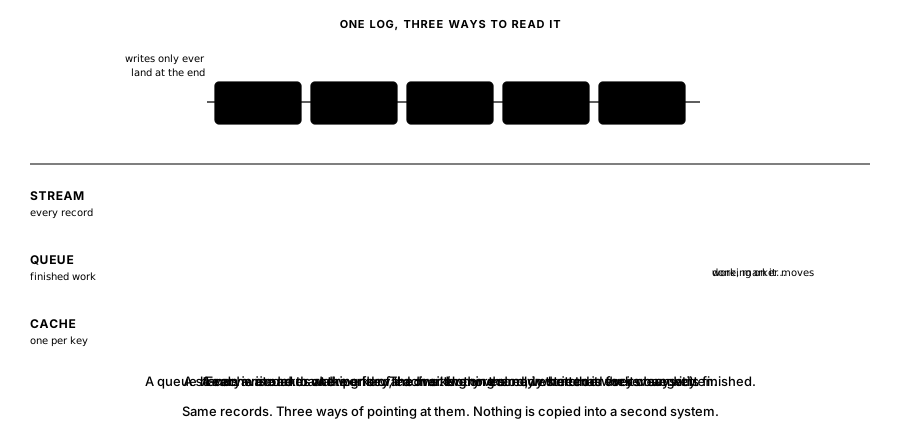
Same records. Three ways of pointing at them. Nothing is copied into a second store, and no reading can disturb another — a worker finishing a job cannot move a subscriber’s position, and overwriting a key adds a record rather than destroying one.
The precise version of this, with the test behind each claim, is Projections.
What that gets you
Section titled “What that gets you”Because the three readings share one log, they share everything underneath it.
- One thing to deploy. In practice that is brokers plus a control plane — two kinds of process, not one, and that is worth being clear about. But it is one system, one upgrade path, one set of release notes.
- One security model. Access is granted per tenant and checked at the broker, and the same check covers publishing, subscribing and cache operations. One place to reason about who can reach what.
- One durability and replication model. A cache shard is replicated by the same machinery that replicates a stream, because it is the same log. There is one answer to “is this write safe yet,” not three.
- One recovery story. One way a node comes back, one way a torn write at the end of a file is repaired, one meaning for “this record is on disk.”
- One set of things to know. One configuration vocabulary, one set of metrics, one set of failure modes to have seen before.
At 3am that is the whole point. One thing to be paged about. One dashboard. One set of metrics that already means something to you, rather than the third system you touch twice a year. And no class of incident that consists of two systems quietly disagreeing about the same fact.
When not to use Felix
Section titled “When not to use Felix”Plenty of reasons, and most of them are good ones.
-
You already run Kafka in production. It works, your team knows it, and the operational cost you would save is a cost you have already paid. Replacing working infrastructure to reduce system count is rarely worth it.
-
You need Kafka wire compatibility. Felix does not speak Kafka’s protocol, so Kafka Connect, Streams, ksqlDB, Debezium and every tool that expects a Kafka broker will not work against it. If you need that ecosystem, use something that speaks the protocol.
This is a decision rather than a gap nobody got to. A shim was built far enough to measure: 533 lines gets
kcatreading a Felix shard with correct offsets, because Felix’s offsets and shards already have the shape Kafka assumes. What that does not get is the ecosystem, all of which needs the consumer-group coordinator — and a client asked to join a group against a broker that has none does not fail, it hangs in “waiting for group rebalance”. Building the coordinator means building a rebalance protocol Felix deliberately does not have and owning its behaviour across Kafka versions. The full finding, including what everyone else who tried this had to build, is indocs/kafka-shim-spike.md. -
You need AMQP. Exchanges, bindings, topic routing, per-message TTL, priority queues — the whole RabbitMQ model. Felix has none of it. A queue in Felix is a group of workers reading one shard, and that is the extent of it.
-
You need Redis data structures. Felix’s cache is the newest value for a key, with an optional expiry, plus counters. No lists, sets, sorted sets, hashes, streams, scripting or pub/sub channels. If you use Redis for anything beyond “remember this value,” Felix is not a replacement for it.
-
You need long-term history. There is no tiered or cold storage. Retention is bounded by the disks you give the brokers.
-
You need production mileage. Nobody has run Felix in production. If your answer to “who else runs this?” has to be a name, the answer today is nobody.
The honest summary: Felix is worth considering when you are building something new, you can see all three needs coming, and you would rather learn one system than three. It is not worth considering as a replacement for three systems that are already working.
Where it stands
Section titled “Where it stands”Felix is pre-1.0 and in active development. It has not been run in production by anyone, including its author.
What exists today: multi-broker clusters, a durable log with crash recovery, replication with leader leases and failover, a cache with expiry and counters, consumer groups with acknowledgements and redelivery, a control plane over REST, and tenant-scoped tokens with OIDC token exchange.
What does not exist yet:
- Per-stream retention — a policy can be recorded on a stream and nothing reads it. Retention itself works, but it is configured per broker and is off unless you set it, so by default a log grows until the disk does.
- Rebalancing — a shard whose leader is alive is never moved, however uneven that leaves the cluster.
- Tiered storage, cross-region bridges, encryption at rest, and audit logging.
- Clients beyond Rust, Python and TypeScript.
For capability-by-capability detail — what is shipped, what is partial, and what is only intended — read What Felix Is For. It is kept current per capability and it is the page to trust when another disagrees with it.
- What Felix Is For — the status table, and the honest boundaries
- Quickstart — run a broker and publish something
- Projections — the precise version of one log, three readings