
Queues and Consumer Groups
A consumer group reads a stream as work rather than as a broadcast. Where every subscriber to a stream sees every record, the members of a group divide the records between them: one consumer holds a record at a time, and the record is not finished until someone says so.
It is the same log underneath — see Projections — read through a cursor the group shares instead of a cursor per subscriber.
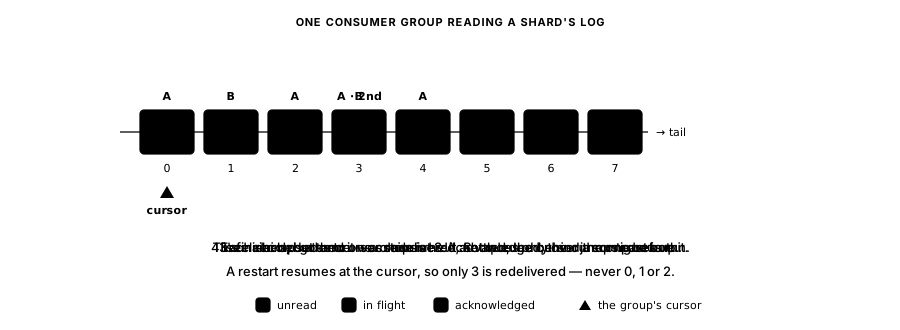
The moment worth watching is the one in the middle. Offset 4 is acknowledged while offset 3 is still held, and the cursor stops at 3 anyway — it only ever advances over a contiguous run of finished records. That is what makes the cursor safe to restart from: everything below it is genuinely done, so a broker that restarts redelivers offset 3 and nothing before it.
The alternative — moving the cursor to the highest acknowledged offset — would be simpler and would silently drop offset 3 on the next restart.
The loop
Section titled “The loop”loop { // Wait up to five seconds for work rather than spinning. let batch = client .group_poll_wait("t1", "default", "jobs", 0, "workers", 16, Duration::from_secs(5)) .await?;
for record in batch { match handle(&record.payload).await { Ok(()) => { client.group_ack("t1", "default", "jobs", 0, "workers", record.offset).await?; } Err(_) => { // Hand it back now rather than waiting out the timeout. client.group_nack("t1", "default", "jobs", 0, "workers", record.offset).await?; } } }}An empty batch means nothing was available, not an error.
What the broker guarantees
Section titled “What the broker guarantees”A record is held by one consumer at a time. While a claim stands, no other poll receives that record.
A claim expires. A consumer that stops answering does not hold a record for
ever: after FELIX_GROUP_VISIBILITY_TIMEOUT_MS the record is owed again and
goes to whoever polls next. This is why the loop above must be able to see the
same record twice.
The cursor moves only over a contiguous run of acknowledgements. If you finish offset 6 while 5 is still outstanding, the group’s saved position stays below 5. Acknowledging out of order is fine; the position simply waits.
Owed records go out before new ones, so a redelivery is not starved behind a fast producer.
an_offset_in_flight_is_not_handed_out_again,a_lapsed_claim_is_handed_out_again,the_cursor_does_not_advance_over_a_gap,owed_records_go_out_before_new_ones.
Retries and giving up
Section titled “Retries and giving up”Every delivery carries attempts, counting this one. 1 is a first attempt;
anything higher is a redelivery, so a consumer can behave differently on a
retry — log it, route it elsewhere, or give up early.
After FELIX_GROUP_MAX_ATTEMPTS deliveries the broker gives up on a record: the
offset is recorded as a dead letter and the group moves past it. Without
that bound, one record that always fails stops the queue at that offset for
ever.
let dead = client.group_dead_letters("t1", "default", "jobs", 0, "workers").await?;for offset in dead { // The record is still in the log at this offset. // Fixed the bug? Put it back: client.group_redrive("t1", "default", "jobs", 0, "workers", offset).await?; // Genuinely unprocessable? Stop tracking it: // client.group_discard("t1", "default", "jobs", 0, "workers", offset).await?;}A dead letter is a pointer, not a copy. The record stays in the stream’s log at that offset, readable by an ordinary replay. Nothing is duplicated, and nothing is moved somewhere you have to go and find.
A redrive resets the record’s attempt count and makes it owed again. It does not move the group’s cursor backwards, so everything already finished stays finished.
a_record_is_given_up_on_after_the_attempt_bound,a_redriven_record_is_handed_out_again,a_redriven_record_gets_its_attempts_back.
What a queue does not promise
Section titled “What a queue does not promise”Order. A shared cursor gives it up the moment two consumers hold adjacent records, and a redelivery reorders regardless of how many consumers there are. A queue preserves the order records are handed out in and says nothing about the order they are finished in. If you need per-key ordering, use a stream with a routing key so related records land on one shard.
Exactly-once. A record can arrive twice — after a claim lapses, after a leader is lost, or after a redrive. Handlers must tolerate seeing the same record again.
A consumer per group member. A group is bound to the shard you name, and nothing assigns shards across a group’s consumers. Running one consumer per shard is the application’s job today; there is no coordinator handing shards out.
A complete picture after a leader failover. Group state travels with its shard, whole: the position and the dead-letter list replicate beside the shard’s records, so a promoted leader resumes where the group had got to, lists which records were set aside, and serves a redrive — proven by killing the leader after a record was given up on and redriving it on the replacement. This used to stop at the position; the dead-letter list stayed behind, and a promotion forgot exactly the records an operator had been told to look at.
Configuration
Section titled “Configuration”| Variable | Default | What it controls |
|---|---|---|
FELIX_GROUP_VISIBILITY_TIMEOUT_MS |
30000 |
How long a claim stands before the record is owed again. Too short redelivers work still being done; too long leaves a dead consumer’s records stuck. |
FELIX_GROUP_MAX_ATTEMPTS |
5 |
Deliveries before a record is dead-lettered. |
FELIX_GROUP_MAX_WAIT_MS |
30000 |
Cap on how long a polling client may ask the broker to wait. |
Groups need durable storage: without FELIX_DURABLE_STORAGE_DIR the broker does
not advertise the feature at all, because a position lost on every restart would
redeliver everything each time.