
Publish/Subscribe
The model is small: publishers send to a stream, every subscriber to that
stream receives what lands on it, and streams are scoped by
(tenant, namespace, stream). What this page is really about is the two
properties the implementation works hardest for — cheap fanout, and the
guarantee that one slow subscriber cannot hurt anyone else.
graph LR
    P1[Publisher 1]
    P2[Publisher 2]
    P3[Publisher 3]

    B[Broker<br/>Stream: orders]

    S1[Subscriber 1]
    S2[Subscriber 2]
    S3[Subscriber 3]
    S4[Subscriber 4]

    P1 --> B
    P2 --> B
    P3 --> B

    B --> S1
    B --> S2
    B --> S3
    B --> S4

    style B fill:#fff3e0,stroke:#334155,color:#111827
    style P1 fill:#e3f2fd,stroke:#334155,color:#111827
    style P2 fill:#e3f2fd,stroke:#334155,color:#111827
    style P3 fill:#e3f2fd,stroke:#334155,color:#111827
    style S1 fill:#c8e6c9,stroke:#334155,color:#111827
    style S2 fill:#c8e6c9,stroke:#334155,color:#111827
    style S3 fill:#c8e6c9,stroke:#334155,color:#111827
    style S4 fill:#c8e6c9,stroke:#334155,color:#111827
Fanout
Section titled “Fanout”A publish is encoded once and the encoded frame is shared by every subscriber, so adding subscribers adds delivery work but not re-encoding work. Measured latency at fanout 1 and 10 (macOS loopback, per-message ack, median of 5–10 trials):
| Fanout | p50 | p99 |
|---|---|---|
| 1 | 109–136 µs | 138–176 µs |
| 10 | 236–269 µs | 278–399 µs |
Fanout above 10 has not been benchmarked; see Benchmarks for methodology and the full tables. Treat behaviour at hundreds or thousands of subscribers as unmeasured.
Batching
Section titled “Batching”Publisher side
Section titled “Publisher side”Send several payloads in one request:
use felix_wire::AckMode;
let mut batch = Vec::new();for i in 0..64 {    batch.push(format!("Event {}", i).into_bytes());}
let publisher = client.publisher().await?;publisher    .publish_batch("tenant", "ns", "stream", batch, AckMode::PerBatch)    .await?;
Batching amortizes per-request overhead (framing, syscalls, one ack for the whole batch), and it is the single biggest throughput lever on the publish path. Measured batch throughput is in Benchmarks — and note that a batched run measures a throughput profile, not request latency.
Acked publishes are pipelined
Section titled “Acked publishes are pipelined”Acked publishes (AckMode::PerMessage / AckMode::PerBatch) do not stall
the stream for the broker’s round trip. The client writes acked requests back
to back and resolves each caller’s future as the matching ack arrives, in
order — so concurrent publishers on the same stream share the stream’s full
bandwidth instead of taking turns paying a round trip each. In-flight acked
data is bounded by the publisher’s byte budget (publish_inflight_bytes,
4 MiB by default): a request holds its budget until the broker’s ack, not
merely until the frame is written.
A single caller that awaits each publish before issuing the next still experiences one round trip per publish, by construction — batch, or publish concurrently, to amortize it.
Broker side
Section titled “Broker side”The broker coalesces events into delivery batches per subscription. A batch flushes when any bound is hit:
event_batch_max_events: 64 # this many events, orevent_batch_max_bytes: 262144 # this many bytes, orevent_batch_max_delay_us: 250 # this much time since the first eventSmall events under a steady load flush on the count bound; big events flush
on bytes; a trickle flushes on the delay, which is therefore the latency
floor batching adds. Delivery uses binary EventBatch framing by default.
Ordering
Section titled “Ordering”Within one stream (strictly: one shard of one stream), subscribers see records in publish order. Across streams there is no ordering relationship at all — two publishes to different streams may be observed in either order. On a multi-shard stream, ordering is per routing key; see Benchmarks and the wire protocol page for how keys map to shards.
Isolation and backpressure
Section titled “Isolation and backpressure”Each subscription gets its own bounded queue in the broker and its own QUIC stream to the client, with its own flow-control window. Backpressure applies at each level:
- QUIC flow control (per connection and per stream) bounds bytes in flight; a full window pauses that stream only.
- The publish queue (
pub_queue_depth) bounds admitted-but-uncommitted publishes; when full, new publishes wait up topublish_queue_wait_timeout_ms, then fail. That failure means the broker is overloaded, and it is deliberately visible. - The subscriber queue (
subscriber_queue_capacity) bounds what one subscription can have pending. What happens when it fills is the overflow policy, and it is the crux:
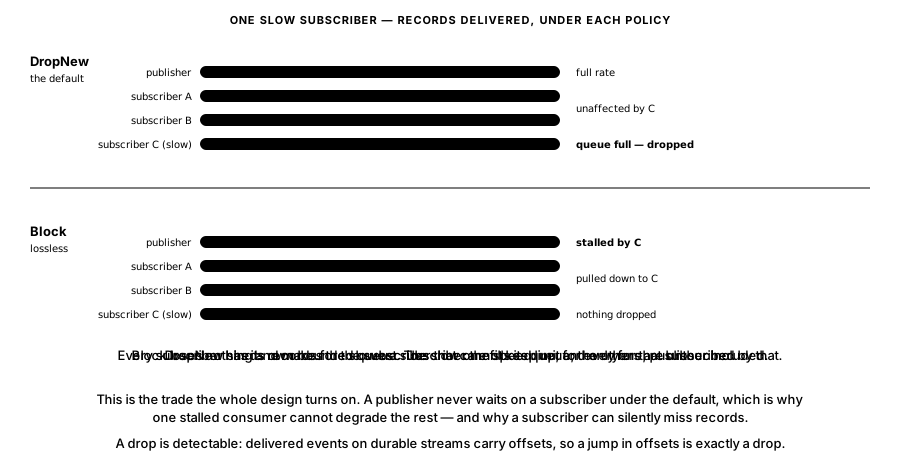
This is the trade the whole design turns on. Under the default a publisher never waits on a subscriber, which is exactly why one stalled consumer cannot degrade the rest — and exactly why a subscriber can silently miss records.
DropOld is accepted in configuration and counted separately, but it currently
behaves as DropNew: the arriving record is the one discarded. The metric
felix_sub_queue_drop_old_emulated_total is what tells you that happened.
Delivery semantics
Section titled “Delivery semantics”At-most-once, per subscriber
Section titled “At-most-once, per subscriber”This is what a plain subscription gives: no subscriber acknowledgements, no redelivery, the lowest latency. The right fit for signals whose old values are worthless — dashboards, telemetry, presence.
Ways a subscriber misses records: it fell behind its bounded queue, the network partitioned, or the broker restarted while the stream was ephemeral. A durable stream keeps its records across a restart, and a subscriber resumes from the offset it last saw.
At-least-once, via a consumer group
Section titled “At-least-once, via a consumer group”A different shape from subscribe: records are pulled, because only the
consumer knows when it has capacity for more work.
- Each record is claimed by one consumer and not handed to another while the claim holds
- An acknowledgement finishes a record; the group’s cursor advances over a contiguous run, so acknowledging out of order cannot skip a gap
- Anything unanswered is redelivered once the visibility timeout lapses
- Redelivery is bounded: past
max_attemptsthe record is dead-lettered - Requires durable storage, and costs a round trip per settle
// Waits up to 5s for work rather than spinning on empty polls.let records = client    .group_poll_wait("tenant", "ns", "orders", shard, "fulfilment", 32, Duration::from_secs(5))    .await?;
for record in records {    match process_order(&record.payload) {        Ok(()) => client.group_ack("tenant", "ns", "orders", shard, "fulfilment", record.offset).await?,        // Hand it back for immediate redelivery instead of waiting out the timeout.        Err(_) => client.group_nack("tenant", "ns", "orders", shard, "fulfilment", record.offset).await?,    }}
record.attempts carries how many times this record has been delivered, so a
consumer can treat a retry differently from a first attempt.
See Queues for dead letters, redrive, and the ordering rules that make the cursor safe.
Exactly-once is not planned
Section titled “Exactly-once is not planned”At-most-once and at-least-once are the two guarantees Felix intends to offer. Deduplicating on receive has to happen in the application in any case — it is the only layer that knows what makes two records the same — so deduplicate there, keyed on something the record carries.
Tuning
Section titled “Tuning”Start with the defaults and change things only off a measurement — the defaults are what Benchmarks measures. The knobs pull in two directions:
Toward latency — smaller batches, shorter delays, shallower queues:
event_batch_max_events: 8event_batch_max_delay_us: 100fanout_batch_size: 8pub_queue_depth: 16subscriber_queue_capacity: 64subscriber_writer_lanes: 2Toward throughput — bigger batches, deeper queues, more connections:
event_batch_max_events: 256event_batch_max_delay_us: 2000fanout_batch_size: 256pub_queue_depth: 512subscriber_queue_capacity: 4096subscriber_writer_lanes: 8let quinn = quinn::ClientConfig::with_platform_verifier();let config = ClientConfig { event_conn_pool: 16, publish_conn_pool: 8, publish_streams_per_conn: 4, event_router_max_pending: 4096, ..ClientConfig::optimized_defaults(quinn)};In a throughput-shaped configuration, per-message latency is dominated by batch fill and queueing — the latency percentiles of a batched run measure the queue, not the request.
How this compares
Section titled “How this compares”Roughly: Kafka is durable-first and batch-oriented, with a far bigger ecosystem and higher per-message latency; Redis pub/sub and NATS (core) are fast fire-and-forget with no per-subscriber isolation or replay. Felix sits between: at-most-once fanout with real isolation, plus durable streams and consumer groups on the same log when you need replay or redelivery. If your workload is heavy stream processing — joins, windows, transformations — that layer does not exist here; use a processing framework on top, or a system that ships one.