
An Architecture Tour
This page is for someone who wants to understand Felix well enough to change it. It follows a single publish from the client’s API call to bytes on disk on three machines, stopping wherever a decision was made that would be surprising if you met it in the code first.
Read it once end to end. It links out at each step, but the links are for afterwards — the point here is the shape.
The one idea
Section titled “The one idea”Felix stores everything in an append-only log, split into shards. A shard is owned by one broker and replicated to others. Streams, caches and queues are three ways of reading that log, not three subsystems.
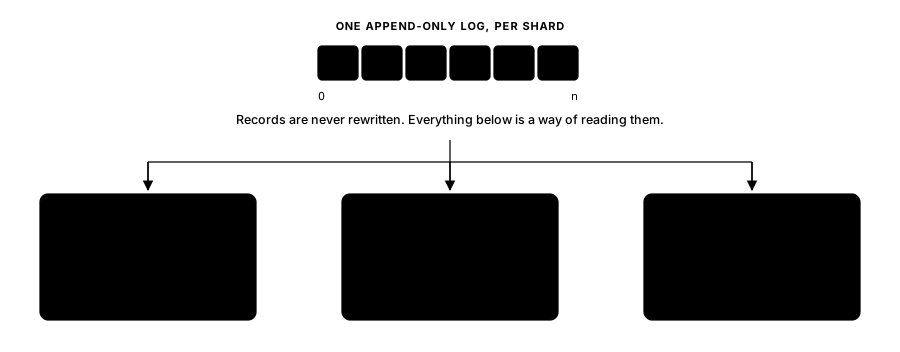
Projections animates that same picture — the three readings advancing over one log at once — and cites the test behind each claim.
Everything that follows is a consequence. There is one durability path, one recovery path, one placement rule and one replication path, and each semantic is a small amount of code on top. When you are deciding where a change belongs, the question is usually “is this about the log, or about one way of reading it?”
Projections is the reference for what each reading stores and rebuilds, with the test behind every claim.
The three processes
Section titled “The three processes”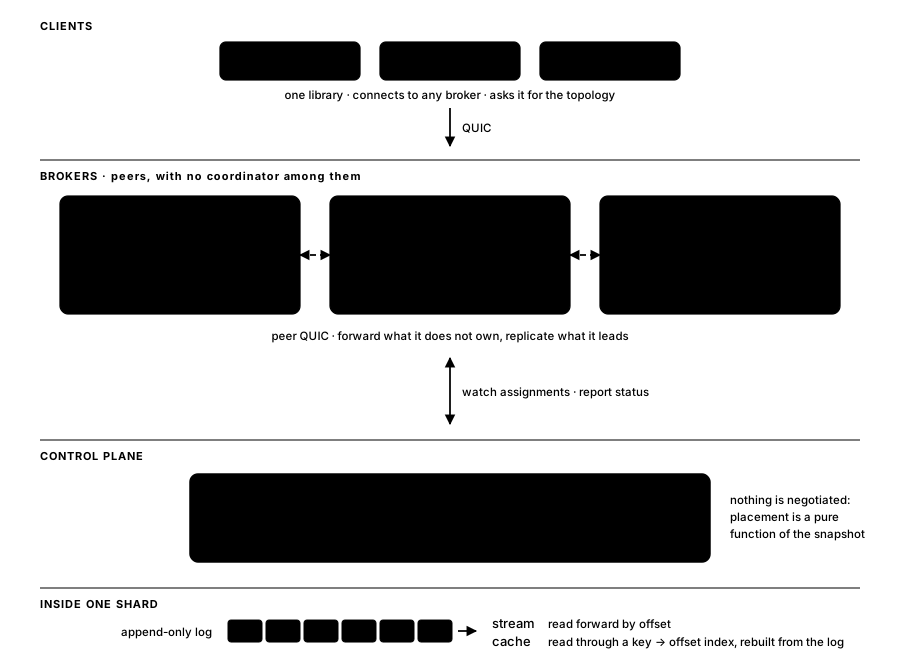
The client (crates/felix-client) is a library. It holds pools of QUIC
connections, encodes frames, and knows how to follow a redirect. It never
decides where data lives.
The broker (services/broker + crates/felix-broker) serves clients over
QUIC and peers over a second QUIC endpoint with its own protocol. It leads some
shards, forwards what it does not lead, and replicates what it leads.
The control plane (services/controlplane) is a stateless REST service over
Postgres. It owns tenants, namespaces, streams, caches, the node catalog, and
shard assignments, and it runs placement on a timer.
The division that matters: the control plane decides ownership, and is never on the data path. A publish does not call it. Brokers read its assignment feed in the background and answer from a routing snapshot they already hold.
Following one publish
Section titled “Following one publish”1. The client encodes a frame
Section titled “1. The client encodes a frame”Client::publisher() gives a handle; publish() takes a tenant, namespace,
stream, payload and an AckMode.
The frame is felix-wire’s: a header with flags that select the payload
layout, then the body. Flags are not a version number. An unknown flag bit is
rejected rather than masked off, because masking one means confidently
misparsing the body.
Separately there are feature bits, exchanged in Auth and AuthOk. Those
say a request exists — “this broker serves cache_delete” — and never appear
on a frame. They are a different number space for that reason. A client must not
send a featured request to a peer that did not advertise the bit: an
unrecognised message type is fatal to a broker’s control loop, so probing costs
the connection rather than returning an error.
crates/felix-wire/src/frame.rs,message.rs.
2. The broker decodes and routes it to a handler
Section titled “2. The broker decodes and routes it to a handler”services/broker/src/transport/quic/ accepts the connection.
streams/control.rs is the control-stream loop: it owns auth state and
dispatches every Message variant. handlers/publish.rs and
handlers/subscribe.rs do the per-message work.
3. Ownership is resolved — locally
Section titled “3. Ownership is resolved — locally”A routing key hashes to a shard. That shard has exactly one owner.
resolve_route in handlers/publish/control.rs is the single chokepoint every
publish passes through, which is why the ownership gate lives there: nothing
reaches storage without it.
Resolving an owner is an atomic load, not a network call. The routing table
is an immutable snapshot swapped in whole (arc-swap), so a reader takes a
cheap atomic load and reads a table nobody can mutate underneath it. This is the
hottest question the broker is asked, and it never touches the control plane.
Three outcomes, and no fourth:
- Local — this broker leads the shard and has opened it. Both are required: the cluster saying it is ours is not the same as the log being recovered.
- Forward — another broker leads it. The publish is sent over the peer protocol and the answer relayed back.
- Refused — nobody can serve it right now, and the reason says which kind of nobody. There is deliberately no “not sure, handle it locally”: a broker that treats an unknown route as its own is a broker writing a shard it does not own.
crates/felix-router/src/shard.rs,services/broker/src/shard_routing.rs.
4. Offsets are taken before durability is waited on
Section titled “4. Offsets are taken before durability is waited on”This is the ordering most likely to be “fixed” into a bug.
crates/felix-broker/src/broker.rs calls begin_append and then commit.
The batch claims its place in the stream’s order the instant its offsets are
consumed, before anyone waits on the disk. commit_order.rs then makes later
publishes wait behind earlier ones — whether those succeed, fail, or are
cancelled, because a cancelled publish that released its successors would let
a later record land at an earlier offset.
5. Storage appends it
Section titled “5. Storage appends it”crates/felix-storage/src/disk_log/ — a log-structured segment store, not a
write-ahead log. Four properties carry it, and all four are load-bearing:
- Records are never rewritten. Recovery can therefore trust “valid bytes end
at EOF”. Preallocation reserves blocks without changing
st_sizefor exactly this reason. - A torn tail is repaired; interior corruption is fatal. Refusing to start beats silently losing acknowledged records.
- Indexes are derived, never trusted. A missing, short or stale index is rebuilt from the segment it describes — which is why it is safe not to fsync a freshly written one.
- Group commit is the biggest throughput lever under
FsyncMode::OnCommit: one blocking flush serves many waiters.
6. Replication ships it, if the stream asked
Section titled “6. Replication ships it, if the stream asked”For a Quorum stream the publish is not acknowledged until a majority of the
shard’s replicas — counting the leader — hold the record.
The leader ships records at their offsets; a follower checks each batch begins at its tail, and answers a gap or a divergence explicitly rather than accepting it. A leader serves only while it holds a lease on the shards it leads, so a broker that has been superseded stops acknowledging rather than finding out later.
On failover, only a replica that actually holds the log is promoted. A shard whose leader is gone and whose replicas are behind is left unavailable rather than reopened empty — a silently empty shard is the data loss, and nothing downstream would report it as one.
docs/replication-design.mdargues this in full, including why per-shard Raft was rejected.
7. Fanout happens after durability
Section titled “7. Fanout happens after durability”crates/felix-broker/src/delivery.rs. One DeliveryEnvelope is shared by every
subscriber and caches its encoded frame, so a publish is encoded once regardless
of fanout.
Subscribers are isolated by construction: each has a bounded queue with an
explicit overflow policy, DropNew by default. A publisher never blocks on a
slow subscriber.
Because dropping is the default, a subscriber can silently miss records — which is why delivered events carry log offsets for a durable stream. A jump between consecutive offsets is exactly a drop, so the loss is at least detectable.
The orderings that are the design
Section titled “The orderings that are the design”Several past bugs were “the natural order”:
| Do this | Not this | Because |
|---|---|---|
| Register the subscriber, then read history | Read history, then register | A publish landing in between is lost |
| Take offsets, then wait for durability | Wait, then take offsets | Order would depend on disk timing |
| Report the replica set, then release the quorum publish | Release, then report | A leader dying in the gap is replaced by a replica that may not hold the record |
| Record the dead letter, then advance the cursor | Advance, then record | A crash between leaves the record skipped with nothing saying it was tried |
If you find yourself reordering one of these, it is almost certainly a bug.
Reading order
Section titled “Reading order”- This page, for the shape.
- What Felix Is For — the status table. It is kept current per capability and is the page to trust when another disagrees.
- Projections — the three readings, with the test behind each claim.
- Delivery Semantics — what is guaranteed, and what is not.
- Wire Protocol — then
docs/internal-protocol.mdfor the broker-to-broker one. - Durable Storage and the segment format.
docs/replication-design.md— the argument, not just the mechanism.- How Felix Works — function-by-function internals, once the shape above is familiar.
Where the code is
Section titled “Where the code is”| Crate | What it owns |
|---|---|
felix-wire |
Frames, message types, capability negotiation, the internal protocol |
felix-transport |
QUIC endpoints and connection setup |
felix-router |
Which node serves a shard, and whether it may be reached |
felix-storage |
Segments, the disk log, recovery, the log-backed cache |
felix-broker |
Streams, delivery, commit ordering, consumer groups |
felix-client |
The client library and its connection pools |
felix-authz |
Tokens, RBAC, and the actions they gate |
services/broker |
The broker binary: QUIC handlers, routing, replication, peers |
services/controlplane |
Metadata, placement, and the REST API |
felix-cluster |
A local multi-broker cluster, for integration and failure tests |
Before you change something
Section titled “Before you change something”Three conventions that will otherwise surprise you, all in CLAUDE.md:
- The demo crates are not workspace members.
task lintandtask testcannot see them, so “this is unused, delete it” is unreliable. Runtask demo:checkafter changing a public API. - The cluster harness runs a prebuilt binary.
cargo test -p felix-clusterdoes not rebuildfelix-broker, so a broker-side change is not in the binary those tests spawn until you build it. This silently invalidates “revert the fix and watch the test fail”. - A regression test that passes without the fix proves nothing. For concurrency and durability work, revert the fix, watch the new test fail, then restore it. Several tests in this repo exist because that step caught a test that was asserting nothing.